USDT TRC20 vs ERC20: Same Dollar, Different Jobs
TRC20 and ERC20 USDT are the same Tether dollar issued on two chains. Allium data shows Tron now holds more USDT than Ethereum and carries ten times its organic transfer volume.

USDT TRC20 and USDT ERC20 are the same dollar stablecoin, issued by Tether on two different blockchains: TRC20 is USDT on Tron, ERC20 is USDT on Ethereum. Each is redeemable through Tether on the same terms, but they run on separate networks, so they are not interchangeable without a swap or an exchange. According to Allium's dataset, Tron now holds more USDT than Ethereum, $92.64B against $78.02B, and carried more than ten times Ethereum's organic transfer volume over the last 30 days (Allium data, November 3, 2026).
Key takeaways
- A year ago Ethereum held more USDT than Tron ($95.47B against $77.14B). Since then Tron gained 20% and Ethereum lost 18%.
- Tron moved $219.6B of organic USDT volume in 30 days, against $21.1B on Ethereum, at an average of $6,907 per transfer.
- Only 2.9% of the USDT volume recorded on Ethereum was organic, against 28.5% on Tron. Most Ethereum USDT movement is DeFi routing and contract activity.
- Sending TRC20 USDT to an address that only accepts ERC20, or the reverse, can lose the funds. The network has to match on both sides.
Which one to use
For sending dollars between wallets or to an exchange, TRC20 is the network most counterparties already accept, and its share of organic USDT volume across chains is about 84%. For using USDT inside DeFi on Ethereum, ERC20 is the version the applications accept. In both cases the receiving address and the network selected have to match. Exchanges list the networks they accept for each deposit address, and a deposit on an unsupported network may not be recoverable.
What TRC20 and ERC20 mean
ERC20 is Ethereum's standard for fungible tokens, and TRC20 is Tron's equivalent, modeled on it. Tether issues USDT natively on both, so neither is a bridged copy of the other. The differences are practical:
| USDT TRC20 (Tron) | USDT ERC20 (Ethereum) | |
|---|---|---|
| Address format | Starts with T | Starts with 0x |
| Fees paid in | TRX, or energy from staked TRX | ETH (gas) |
| Block time | About 3 seconds | About 12 seconds |
| Accepted by | Most exchanges and payment apps, for deposits and withdrawals | Most exchanges, plus Ethereum DeFi applications |
| Adjusted supply, Nov 3, 2026 | $92.64B | $78.02B |
| Organic volume, 30 days | $219.6B | $21.1B |
| Organic transfers, 30 days | 31.8M | 4.6M |
| Average organic transfer | $6,907 | $4,575 |
| Typical use | Exchange deposits, payments, remittances | DeFi collateral, trading, treasury |
Allium data. Supply as of November 3, 2026; adjusted (organic) volume Oct 5 to Nov 3, 2026.
Fees change with network conditions, so the cost of one transfer is best checked in the wallet or exchange at the time of sending.
Where USDT is actually used
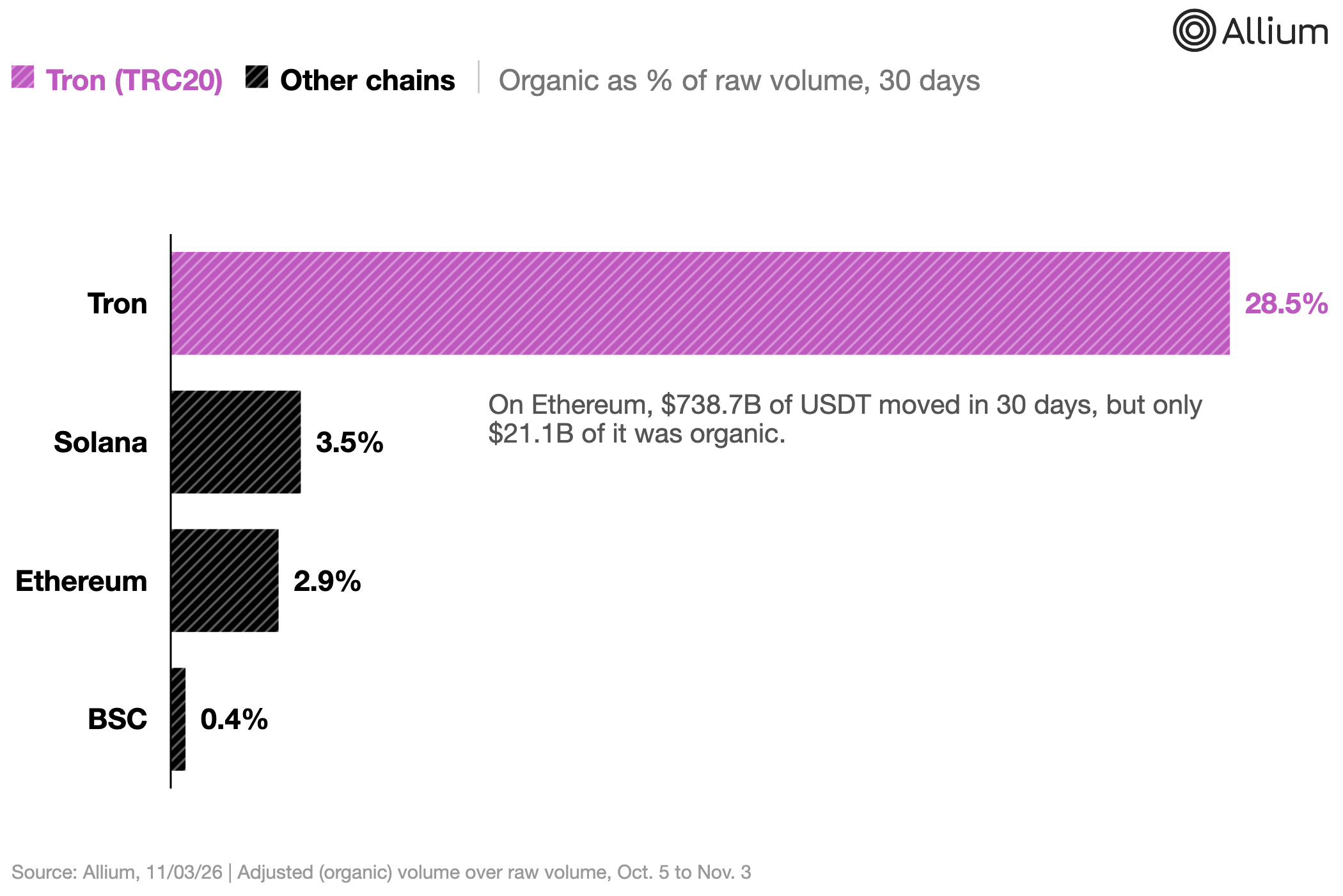
Raw transfer volume makes Ethereum and Tron look similar: $738.7B and $770.7B over the 30 days. Most of Ethereum's figure is the same dollars moving through lending pools, DEX routers and other contracts, so it counts activity many times over. Once that is filtered out, Ethereum's organic USDT volume is $21.1B and Tron's is $219.6B.
The two chains do different jobs. Tron's USDT turns over about 2.4 times its supply in a month, mostly in direct transfers between wallets and exchanges, which is what a payment rail looks like. Ethereum's turns over about 0.3 times: the dollars are held, posted as collateral and traded against, but rarely sent from one person to another. BSC is the extreme case, with $3.66T of raw volume and $16.4B organic, 0.4%.
How these figures are measured
Allium's adjusted circulating supply starts from total supply and removes issuer reserves, bridge escrows, protocol collateral, savings vaults and frozen addresses, so it measures the supply that is actually free-floating. Organic volume uses Allium's adjusted volume method, which filters out transfers that do not reflect economic activity, such as contract-internal movements, liquidity routing and repeated hops of the same funds. Both are computed per chain and per token across 150+ chains in Allium's stablecoin datasets, so TRC20 and ERC20 USDT resolve to the same issuer while staying separate by network. For USDT across all its chains, see how USDT works, USDC vs USDT and USDT0, Tether's cross-chain format.
Frequently asked questions
Is USDT TRC20 the same as USDT?
Yes. It is USDT issued by Tether on the Tron network, redeemable through Tether on the same terms as USDT on other chains.
What is the difference between TRC20 and ERC20 USDT?
The network. TRC20 USDT runs on Tron and uses addresses starting with T; ERC20 USDT runs on Ethereum and uses addresses starting with 0x. Fees are paid in TRX and ETH respectively.
Can I send TRC20 USDT to an ERC20 address?
No. The sending and receiving network must match. Sending on the wrong network can lose the funds unless the recipient platform supports recovery.
Which chain has the most USDT?
Tron, with $92.64B of adjusted supply on November 3, 2026, against $78.02B on Ethereum, according to Allium.
Why is so little Ethereum USDT volume organic?
Most USDT movement on Ethereum passes through DeFi contracts and routers, which counts the same dollars many times. Allium's organic measure filters that out, leaving 2.9% of raw volume.
See the data behind this post. Browse the stablecoin tables, or read How to Monitor Stablecoin Balances Across Chains for how the records are put together.
Tracking USDT flows across Tron, Ethereum and 150+ other chains? Talk to the team.
Allium provides onchain data infrastructure. Companies named in this article may be Allium customers, prospects or commercial counterparties. The authors and other Allium personnel may hold positions in the assets discussed. This article is informational only and is not investment, legal or tax advice. Data and information last reviewed: November 5, 2026.