USDT0: Where Tether's Cross-Chain Dollar Is Used
USDT0 is a cross-chain format of USDT, backed one for one by USDT locked on Ethereum. Its supply fell a third in a year while it spread to more chains, and Plasma now moves the most of it.

USDT0 is a cross-chain format of Tether's USDT: each token is backed one for one by USDT locked on Ethereum and issued on another chain through LayerZero's token standard, so the same dollar can move between chains without a separate wrapped version on each. According to Allium's dataset, USDT0 has $3.20B of free-floating supply across 16 chains, down from $4.75B on 14 chains a year earlier, and the chain that uses it most is Plasma (Allium data, November 3, 2026).
Key takeaways
- USDT0 supply fell 33% in a year, from $4.75B to $3.20B, while the number of chains carrying it rose from 14 to 16.
- Plasma holds slightly less USDT0 than Arbitrum ($789.3M against $820.2M) but moved $1.64B of organic volume in 30 days, 2.8 times Arbitrum's.
- Polygon carries the most transfers, 1.98 million in 30 days at an average of $547, which looks like payments rather than trading.
- Where a chain carries USDT0, USDT usually does not appear under its own ticker, so a USDT total that skips USDT0 understates Tether-linked liquidity.
How USDT0 works
Bridged stablecoins usually create a new token per bridge: lock USDT on Ethereum, receive a bridge's own version elsewhere, and end up with several incompatible "USDT" tokens on one chain. USDT0 replaces that with one token standard across chains. USDT is locked in a contract on Ethereum, and USDT0 is minted on the destination chain against it. Moving USDT0 between two chains burns it on one and mints it on the other, so the total stays tied to the locked USDT.
For a holder, USDT0 is a claim on USDT held in that Ethereum contract, and USDT is in turn a claim on Tether's reserves. Redemption for dollars still runs through USDT.
Where USDT0 is actually used
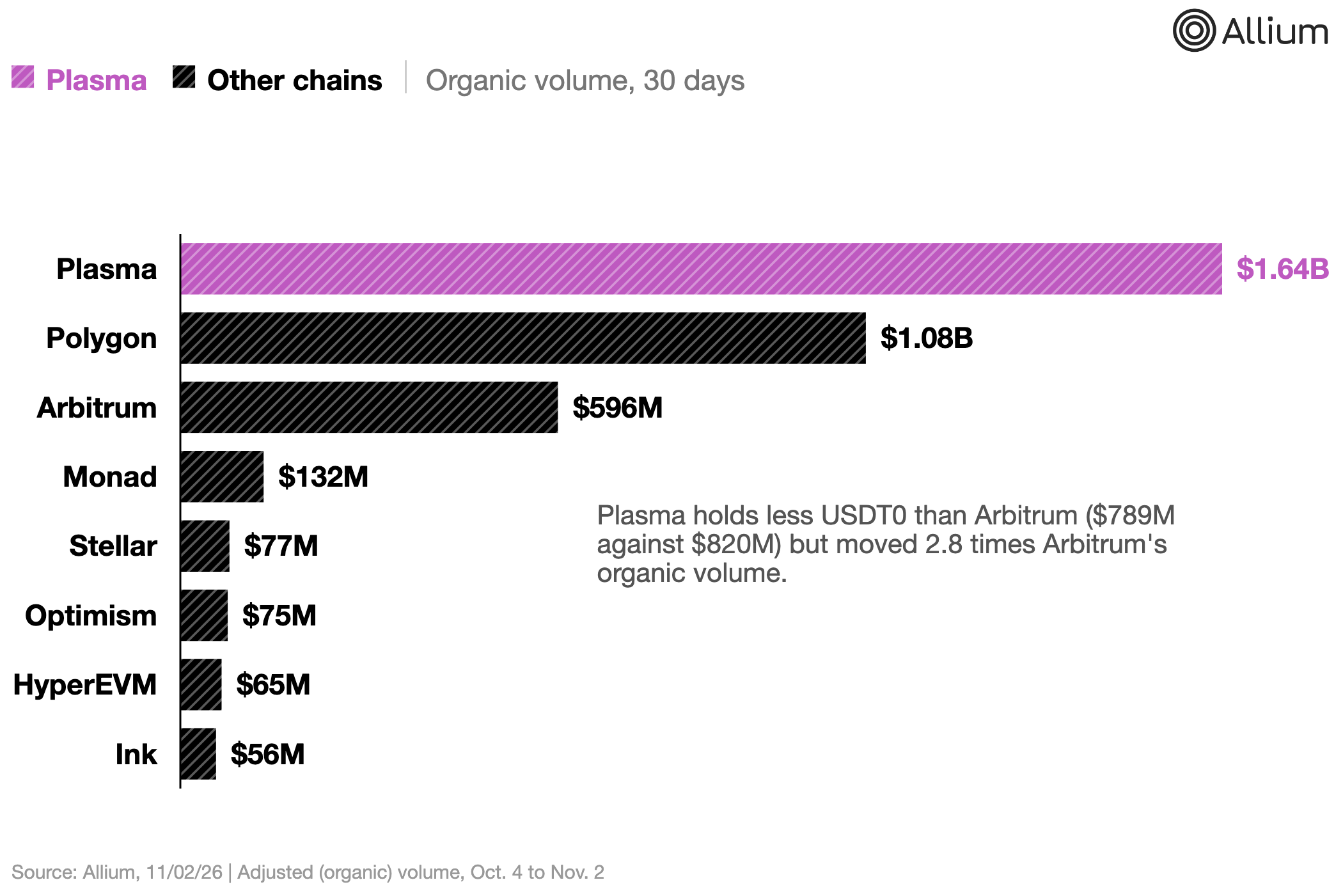
Supply shows where USDT0 sits. Organic volume shows where it moves, and the two rank the chains differently.
| Chain | Adjusted supply | Organic volume, 30 days | Transfers | Average transfer |
|---|---|---|---|---|
| Arbitrum | $820.2M | $596.2M | 1.09M | $549 |
| Plasma | $789.3M | $1,644.8M | 928K | $1,772 |
| Polygon | $736.4M | $1,082.4M | 1.98M | $547 |
| Mantle | $429.2M | under $56M | ||
| HyperEVM | $54.6M | $65.0M | 23.5K | $2,762 |
| Monad | $41.0M | $131.5M | 6.9K | $19,152 |
Allium data. Supply as of November 3, 2026; adjusted (organic) volume Oct 4 to Nov 2, 2026.
Three patterns stand out. Plasma turns its USDT0 over fastest: organic volume was about twice its supply in a month, consistent with a chain built around moving stablecoins. Polygon looks like payments: the most transfers of any chain at a small average size. Mantle holds a lot and moves little: $429.2M of supply with organic volume too small to make the top eight, which is what dollars parked in protocols look like. Monad's few, very large transfers point the other way, toward desks and treasuries moving size.
Why USDT0 matters when counting Tether-linked dollars
On chains where USDT0 is the standard, USDT barely appears under its own ticker. A dashboard that counts "USDT" by symbol will show Arbitrum or Plasma as almost empty of Tether-linked dollars when they hold hundreds of millions. The opposite error is also easy: count the USDT locked on Ethereum and the USDT0 issued against it, and the same dollars appear twice.
Allium's adjusted circulating supply starts from total supply and removes issuer reserves, bridge escrows, protocol collateral, savings vaults and frozen addresses, so it measures the supply that is actually free-floating. Because bridge escrows are excluded, the USDT locked behind USDT0 is not counted alongside the USDT0 it backs. Each deployment resolves to the same fields, issuer, chain, contract, native or bridged status and USD value, across 150+ chains in Allium's stablecoin datasets, with organic volume measured by Allium's adjusted volume method. For how USDT itself is distributed, see USDC vs USDT and how USDT works.
Frequently asked questions
Is USDT0 the same as USDT?
It is backed one for one by USDT locked on Ethereum, so it carries the same dollar claim, but it is a separate token contract used on other chains.
Which chains use USDT0?
Allium tracks USDT0 on 16 chains. The largest by supply are Arbitrum, Plasma, Polygon and Mantle; by organic volume, Plasma, Polygon and Arbitrum lead.
How much USDT0 is there?
$3.20B of adjusted supply on November 3, 2026, according to Allium, down from $4.75B a year earlier.
Can USDT0 be redeemed for dollars?
Not directly. USDT0 is redeemed for USDT, and USDT is redeemed for dollars through Tether on its published terms.
Why does USDT not show up on some chains?
On chains that adopted USDT0, Tether-linked dollars circulate under the USDT0 ticker, so a count by the USDT symbol alone misses them.
See the data behind this post. Browse the stablecoin tables, or read How to Monitor Stablecoin Balances Across Chains for how the records are put together.
Building something that needs this data? Talk to the team.
Allium provides onchain data infrastructure. Companies named in this article may be Allium customers, prospects or commercial counterparties. The authors and other Allium personnel may hold positions in the assets discussed. This article is informational only and is not investment, legal or tax advice. Data and information last reviewed: November 4, 2026.