USDC vs USDT: Same Dollar, Different Markets
USDT and USDC are both dollar stablecoins redeemable 1:1 by their issuers. The sharper difference is the market each serves: 84% of organic USDT volume runs on Tron in large transfers, while USDC splits between Ethereum and small app payments on Solana and Base.

USDT and USDC are both dollar stablecoins that their issuers redeem 1:1 for onboarded customers, so the useful differences are in reserves, redemption terms, and the markets each token actually serves. According to Allium's dataset, 84% of USDT's organic transfer volume in the last 30 days ran on Tron in transfers averaging about $6,800, while USDC's activity splits between large transfers on Ethereum and small, app-sized payments on Solana and Base.
Key takeaways
- USDT has $184.17B of adjusted onchain supply and USDC $62.84B, a ratio of about 2.9 to 1 (Allium data, November 3, 2026).
- By organic transfer volume the gap is wider: $254.3B for USDT against $45.8B for USDC over 30 days, about 5.6 to 1.
- The chain sets the ticket size more than the token does. Average organic transfers run about $6,800 for USDT on Tron and USDC on Ethereum, and about $300 for USDC on Solana and Base.
- On chains such as Arbitrum and Plasma, Tether-linked dollars circulate as USDT0 rather than under the USDT ticker.
Reserves, redemption and risk
USDT is issued by Tether and launched in 2014. USDC is issued by Circle and launched in 2018. Each publishes its own reserve reports, and those reports, rather than secondary summaries, are the place to check current reserve composition and terms.
| USDT | USDC | |
|---|---|---|
| Reserve reporting | Quarterly attestation reports by an independent accounting firm, on Tether's transparency page | Monthly reserve reports with independent accountant assurance, on Circle's transparency page |
| Reserve composition, per the issuer | Mostly US Treasury bills and related short-term instruments, with other categories listed in the reports, including gold and bitcoin | Cash and short-dated US Treasuries, much of it held in the Circle Reserve Fund, an SEC-registered government money market fund |
| Who can redeem directly | Verified customers, on the issuer's published terms | Verified customers, on the issuer's published terms |
| Everyone else | Exchanges, OTC desks and payment providers | Exchanges, OTC desks and payment providers |
| Can the issuer freeze tokens? | Yes, at specific addresses | Yes, at specific addresses |
| Past stress | Traded below $1 briefly in May 2022, during the Terra collapse | Traded below $1 in March 2023, after the failure of Silicon Valley Bank, where part of its reserves were held |
Both recovered their peg in those episodes. The practical risks for a holder are the same in kind for both tokens: the quality and custody of reserves, the issuer's ability to freeze addresses, and access to redemption, which for most users runs through an intermediary.
What the flows say about who uses each
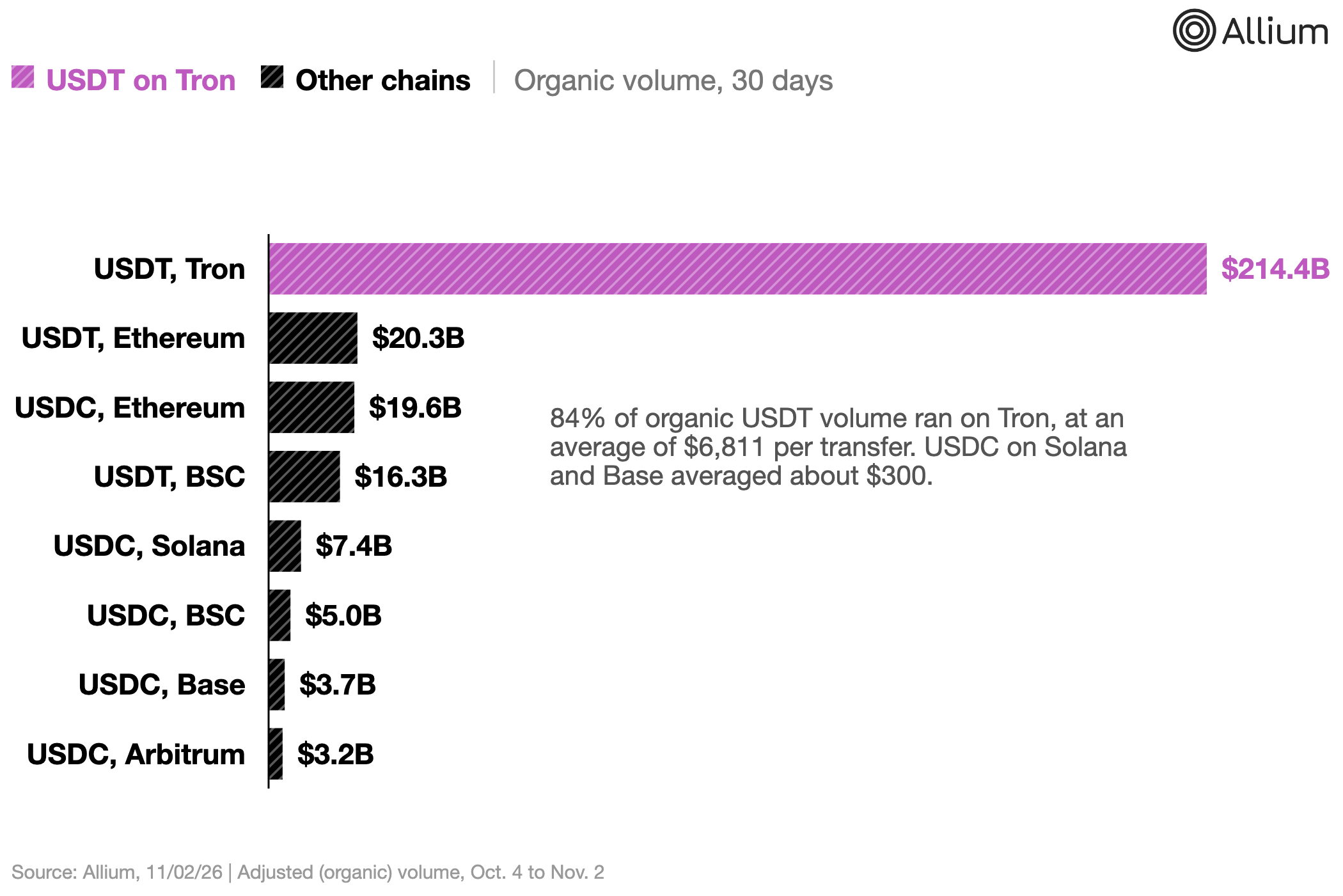
Supply shows where dollars sit. Transfer volume shows what they are used for, and the two tokens look very different.
- Tron USDT is large-ticket dollar settlement. $214.4B of organic volume across 31.5 million transfers in 30 days, averaging $6,811. That profile fits exchange settlement, OTC desks, business payments and cross-border flows better than retail checkout.
- Ethereum is the large-ticket layer for both. USDC on Ethereum averages $6,834 per organic transfer and USDT $4,467. This is where treasuries, funds and DeFi positions move.
- Solana, Base and BSC carry small tickets. USDC averages $305 on Solana and $294 on Base, and USDT $456 on BSC. That is app-sized activity: wallets, trading apps and payments.
- USDT turns over faster. Its organic volume over 30 days was 1.38 times its supply. For USDC it was 0.73 times.
These are averages, so they describe the shape of activity on each chain rather than any individual user. The pattern is still clear enough to be useful: a business choosing between the two is usually choosing a market, and the market is defined by the chain.
Where each one circulates
| Chain | USDT | USDC |
|---|---|---|
| Ethereum | $78.02B | $41.31B |
| Tron | $92.64B | $27.9M |
| Solana | $2.27B | $6.69B |
| BSC | $9.19B | $1.59B |
| Base | $27.0M | $4.33B |
| Arbitrum | $820.2M as USDT0 | $2.24B |
| Hyperliquid | $54.6M as USDT0 (HyperEVM) | $2.63B |
| Arc | none | $1.15B |
Allium data, November 3, 2026, adjusted circulating supply.
USDT0: Tether-linked dollars under another ticker
A missing USDT figure on a chain does not mean Tether-linked liquidity is missing. USDT0 is a cross-chain format backed one for one by USDT locked on Ethereum and issued on other chains through LayerZero's token standard. Allium tracks $3.20B of it, with the largest deployments on Arbitrum ($820.2M), Plasma ($789.3M), Polygon ($736.4M) and Mantle ($429.2M). On those chains, a reader looking for "USDT" should look for USDT0.
Why the two totals are hard to compare
Allium's adjusted circulating supply starts from total supply and removes issuer reserves, bridge escrows, protocol collateral, savings vaults and frozen addresses. It is Allium's estimate of the supply that is actually free-floating, and it is the figure used throughout this article. On that basis Allium tracks $298.47B of stablecoins, against $326.41B before those exclusions. Because bridge escrows are removed, collateral locked behind a bridged token such as USDT0 is not counted alongside the token it backs.
Volume needs the same care. Raw transfer counts include large amounts of non-organic activity: on Base, USDC recorded $2,436.5B of raw transfer volume in 30 days, against $3.7B of organic volume. Allium's adjusted volume filters out non-organic transfers, which is what makes the chart above comparable across chains. Every figure in this article resolves to the same fields per deployment, issuer, chain, contract, native or bridged status and USD value on one date, across 150+ chains in Allium's stablecoin datasets. For issuer-level detail, see how USDT works and USDC measured onchain.
Frequently asked questions
Is USDT bigger than USDC?
Yes. Allium's data shows $184.17B of adjusted onchain USDT supply against $62.84B of USDC on November 3, 2026, and about 5.6 times USDC's organic transfer volume over the prior 30 days.
Why is so much USDT on Tron?
Low transfer fees made Tron a default network for moving USDT between exchanges, desks and businesses. $214.4B of organic USDT volume ran there in 30 days, 84% of the total.
How are USDT and USDC reserves reported?
Tether publishes quarterly attestation reports and Circle publishes monthly reserve reports, each on its own transparency page. Check those pages for current composition.
What is USDT0?
USDT0 is a cross-chain format backed one for one by USDT locked on Ethereum. Allium tracks $3.20B of it, led by Arbitrum, Plasma, Polygon and Mantle.
Can either issuer freeze my tokens?
Both Tether and Circle can freeze tokens held at specific addresses, typically in response to law enforcement requests or sanctions.
See the data behind this post. Browse the stablecoin tables, or read How to Monitor Stablecoin Balances Across Chains for how the records are put together.
Building something that needs this data? Talk to the team.
Allium provides onchain data infrastructure. Companies named in this article may be Allium customers, prospects or commercial counterparties. The authors and other Allium personnel may hold positions in the assets discussed. This article is informational only and is not investment, legal or tax advice. Data and information last reviewed: November 4, 2026.