
What Is Stablecoin Attribution? Why It’s Replacing Stablecoin Volume as the Standard


The stablecoin market is no longer a companion to the crypto market, it’s a major player moving significant amounts of money.
According to Allium’s recent stablecoin report, total circulating supply of the stablecoin market reached $266.3 billion as of February 2026. That’s more than the GDP of about 150 countries.
The stablecoin market supply increased 41% in the past year, with $79 billion added to the market — in fact, supply has grown almost 10% quarter-over-quarter since 2023.
But while these numbers paint a clear picture of expansion, they don’t tell us much about what’s actually happening in the stablecoin market. Volume is an easy metric to compare, and early crypto markets needed only simple signals. But with stablecoins growing at such a scale, volume is a shortcut that no longer works. Instead, stablecoin attribution is the essential metric.
Stablecoins now settle nearly $1 trillion per month in adjusted volume: they’re clearly already systemic infrastructure. But this volume alone doesn’t tell us anything without attribution. Stablecoin attribution is the process of classifying stablecoin transactions by counterparty type, use case, geographic and behavioural patterns. It distinguishes retail transfers from treasury rebalancing, commercial settlements, exchange flows or internal transfers.
Volume tells us how much, stablecoin attribution tells us who, where, and how.
Why Stablecoin Volume Alone Is Misleading Without Attribution
While volume does tell us some important information about the stablecoin market, it simply doesn’t tell us enough. One number can represent many different things — like retail transfers, treasury movement, market-maker churn or commercial settlements, to name a few.
If a team requires data that they can trace, explain and defend, the volume narrative is too simple for their needs. Collapsing all stablecoin information into the volume bucket distorts important signals. Generic, aggregate dashboards can show total stablecoin movements, but lack the distinctions of which segments are active (like hedge funds, corporations, or retail users) and where opportunities could exist.
And unverified data won’t stand up to compliance requirements. If a dashboard aggregates data from more than one provider, or segment just by protocol, it will be impossible to follow the trail of data with the level of detail required for audits or regulatory checks.
Institutions using stablecoin data need to know real things about stablecoin movements, like:
- Who is driving volume?
- Is the stablecoin usage persistent or episodic?
- Is growth commercial, financial or internal?
Moving away from the volume narrative into the attribution narrative is necessary to answer these questions.
How Stablecoin Attribution Improves Market Analysis
Attribution isn’t just another analytics feature — it’s a structural shift in how we interpret stablecoin activity. While volume tells you how much moved, attribution answers what kind of activity it was, who was behind it, and when it occurred.
By classifying transactions by use case, counterparty type, transaction size, and temporal patterns, attribution surfaces insights invisible in aggregate totals. For example, data dashboards like Allium Terminal distinguish everyday consumer transfers from large commercial settlements or treasury rebalancing — each of which carries different risk, liquidity, and operational implications.
These distinctions matter for institutions. Pricing, risk assessment, and product strategy all rely on knowing who is driving activity. Without attribution, decisions are built on incomplete or misleading signals.
Ultimately, attribution converts raw blockchain data into interpretable market structure. It turns numbers into knowledge, and knowledge into actionable insight — the kind institutions need to operate within compliance frameworks and crypto teams need to make the right data-based decisions for their clients and product.
Geography Shows Why Attribution Matters
As one example of why attribution is so much more important than just stablecoin volume, Allium’s recent stablecoin report reveals where exactly stablecoins are being used around the world, beyond just their regional volume.
The going assumption is that stablecoins, due to their fixed price nature, are most often used as payments for cross-border transactions. This has been the narrative since stablecoins came into existence — early stablecoins often based their strategy entirely on attracting clients in parts of the world with high remittance usage.
But the data doesn’t support this narrative anymore. According to Allium’s stablecoin report, even though the Asia-Pacific region accounts for almost half (45%) of stablecoin payments, these are both outflows and inflows from within the APAC region itself.
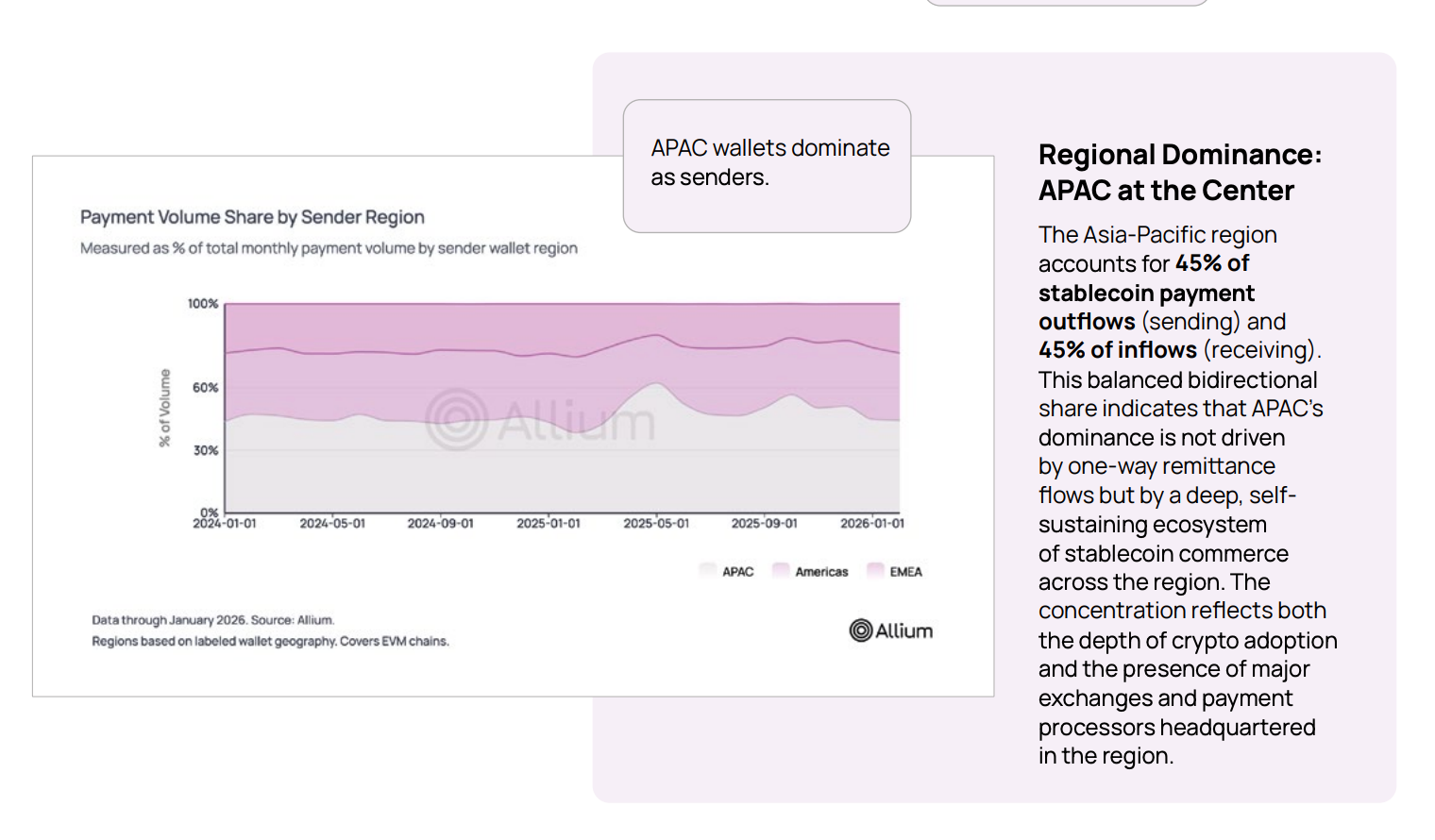
As the report then writes, “The single most important geographic finding [...] is the dominance — and growth — of intra-regional payment flows. 84% of all stablecoin payment volumes flows within the same region, and that share has been growing. Intra-regional flows are expanding faster than cross-regional flows, with cross-region volume dropping from 27% to 15.5% as a share of total payment volume.”
The data makes it very clear — the ongoing assumption that stablecoins are mainly used for remittances is out-of-date. Volume alone couldn’t have provided this explanation, attribution was needed to look deeper into the data itself to find out where the stablecoins were going.
And geographic distribution matters beyond just changing the narrative. Market expansion and regulatory exposure hinge on where stablecoin activity actually happens, not just where tokens are issued or minted. Aggregate totals can make it look like activity is concentrated in one jurisdiction, but attribution reveals the true flow of funds: which countries are sending and receiving payments, which regions are driving commercial adoption, and where systemic risks accumulate.
For example, a stablecoin issued in the US may be primarily circulating within APAC markets or facilitating domestic transfers in emerging economies. Strategies built solely on issuance location risk misallocating resources, targeting the wrong markets, or underestimating compliance obligations. Regulators, meanwhile, care about the on-the-ground flow of funds, because cross-border exposures, AML obligations, and reserve transparency are determined by where activity settles, not where a smart contract was deployed.
In short, understanding geographic attribution allows institutions to expand strategically while managing regulatory and operational risk, turning opaque blockchain data into actionable insight.
FAQs About Stablecoin Attribution and Volume
Why do people focus so much on stablecoin volume?
Volume is a simple, chain-native metric that signals adoption and liquidity. It’s easy to use for reports and comparisons across assets. Early in the market, it was the default proxy for growth and market relevance.
Does high stablecoin volume mean a market is profitable?
Not always. High volume can reflect internal transfers, high-frequency trading or temporary usage spikes. But without understanding who is moving the funds, and why, volume alone can be a misleading indicator.
Can stablecoin attribution be entirely automated?
While some aspects can be automated (like wallet heuristics or protocol-level classification), true institutional-grade attribution requires methodological rigor, data lineage, and auditable processes.
How does stablecoin attribution help with compliance?
Regulators care about transaction monitoring, counterparty identification, and reserve transparency, all facets of stablecoin attribution. Attribution ensures that data can be traced, explained and defended. Raw volume doesn’t provide that type of data.
Can stablecoin volume and attribution be integrated into internal systems?
Yes. Institutional teams can integrate attribution-ready data into reporting dashboards or product workflows.
After Attribution Becomes Standard
Stablecoin attribution is not an optional analytics layer. It is becoming the foundation of institutional-grade stablecoin data.
As stablecoins integrate deeper into global payment systems and financial infrastructure, the ability to classify, trace, and defend transaction activity will define which analytics platforms institutions trust.
The next phase of onchain finance will not be defined by how much stablecoins move, but by who can attribute those movements with clarity and confidence.


