ERC-8004: The Ethereum Standard for AI Agent Identity
ERC-8004 gives autonomous AI agents a shared trust layer on Ethereum through identity, reputation, and validation registries. Here is how it works and who is building on it.

ERC-8004 is an Ethereum standard that answers a single hard question: how can different AI agents trust each other?
As more applications run with little or no human oversight, AI agents can already ideate, create, purchase, and build. A human vetting a potential client can check references or reviews. An autonomous agent has no built-in way to do the same when it meets another agent it has never worked with.
ERC-8004, also called “Trustless Agents,” is an Ethereum standard that creates a trust layer allowing AI agents to work together based on identity, reputation, and validation.
Agents can already talk to each other through communication protocols like A2A and MCP. ERC-8004 adds the missing layer of trust and accountability to those conversations.
What Is ERC-8004? The Ethereum Standard Explained
ERC-8004 is an Ethereum standard that creates a trust layer for autonomous AI agents through three onchain registries: identity, reputation, and validation. It is the piece of Ethereum infrastructure that lets AI agents prove who they are, carry a portable track record, and have their work independently verified.
First proposed in August 2025, the standard was created by a team of contributors from MetaMask, the Ethereum Foundation, Google, and Coinbase. Through 2026 it remains an application-layer standard built on existing Ethereum primitives rather than a change to the protocol itself.
ERC-8004 is not a token standard like ERC-20, ERC-721, or ERC-1155. Those standards define assets with balances or economic value. ERC-8004 is not a fungible token, it cannot be traded, and it does not represent value on its own.
That distinction matters. ERC-8004 uses NFTs (specifically ERC-721) to internally represent agent identities, but the standard itself is about coordination and trust, not value transfer. The NFT is a container for identity rather than a speculative asset.
The goal behind ERC-8004 is to make agents discoverable and accountable across networks, enabling permissionless coordination between AI systems, APIs, and other machine actors without relying on centralized trust intermediaries.
Is ERC-8004 a Token Standard?
No. ERC-8004 is a coordination and trust standard, not a token standard. It borrows ERC-721 to mint a non-transferable identity for each agent, but the purpose of that identity is discovery and accountability. There is no fungible balance, no transfer of value, and no token to trade. If you are searching for an "ERC-8004 token," the practical answer is that the identity NFT exists to anchor reputation and validation records, nothing more.
How ERC-8004 Architecture Works
ERC-8004 defines three interoperable onchain registries that together enable public discovery, reputation, and verification for autonomous agents.
The three registries (Identity, Reputation, and Validation) allow agents to discover each other, evaluate trustworthiness, and verify claimed actions.
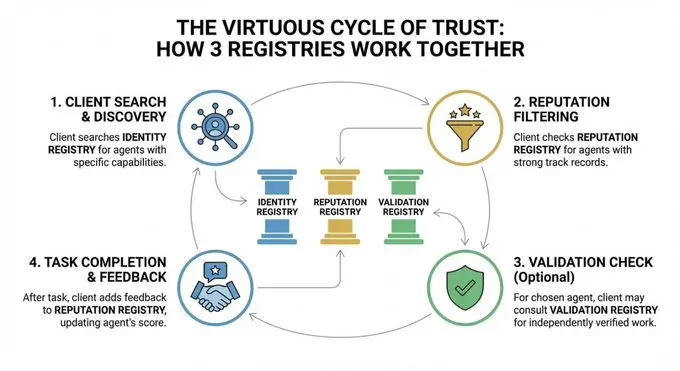
Source: Marcello Politi, Medium
Identity Registry
The Identity Registry is a global directory of AI agents. It assigns each agent an onchain identity through an ERC-721 NFT, linked to metadata such as the agent's name, description, supported endpoints, wallet addresses, and other identifiers. That structure lets other agents and systems programmatically discover and interact with an agent.
The Identity Registry is the anchor for everything else in ERC-8004. Reputation records and validation proofs both point back to the identity NFT, so an agent's history follows its identity across applications rather than living in a single platform's private database. When you look up an ERC-8004 agent, you resolve its identity in this registry first, then read the reputation and validation attached to it.
Reputation Registry
The Reputation Registry standardizes how feedback about agents is recorded onchain. It serves as a persistent, queryable history of ratings and evaluations submitted by clients or other agents after interactions.
By making reputation data public and composable, the registry lets agents and applications fold trust signals (past performance, reliability, dispute outcomes) into their decision-making instead of trusting an unknown counterparty blind.
Validation Registry
The Validation Registry standardizes how agent actions are independently verified onchain. It addresses a plain question: how do you know an agent actually did what it claims to have done?
The Identity Registry answers who an agent is, and the Reputation Registry records what others say about it. The Validation Registry provides a standardized way to attach verifiable evidence to an agent's actions.
At a high level, the Validation Registry defines:
- how validation providers are registered
- how validation results are referenced onchain
- how third parties can verify agent outputs without trusting the agent itself
ERC-8004 does not mandate a single validation technique. It defines a common interface so multiple validation mechanisms (cryptographic proofs, trusted execution environments, independent re-execution) can coexist and be compared.
ERC-8004 Agent Trust and Behavior Verification
Trust in ERC-8004 is the combined output of the three registries working together, and behavior verification is where that combination becomes practical.
Behavior verification answers whether an agent actually behaves the way its identity and reputation suggest. In ERC-8004 the flow works like this:
- Resolve the agent's identity through the Identity Registry to confirm the wallet and metadata are authentic.
- Read the agent's onchain reputation to see how prior counterparties rated its work.
- Require a validation record for the specific claimed action before releasing payment or granting further permissions.
This is where projects like Nevermined fit in. Nevermined builds payment and settlement infrastructure for AI agents, and its work on ERC-8004 focuses on tying agent payments to verifiable behavior. In practice that means an agent only gets paid once the validation record confirms it did the work it claimed, and that outcome is written back to the Reputation Registry so future counterparties can see it. This approach treats behavior verification as the gate between an agent taking a job and an agent getting paid, which turns reputation from a passive score into an enforced condition of commerce.
The broader point for behavior verification is that ERC-8004 makes the evidence portable. A validation result attached to an agent's identity can be read by any application, so an agent that reliably performs and gets verified accumulates trust that follows it everywhere, and an agent that fails validation carries that record too.
ERC-8004 and Agent Security
Agent security is where ERC-8004 does its heaviest lifting. An autonomous agent that can move funds, sign transactions, or hire other agents is a large attack surface. Without shared infrastructure, every application has to reinvent how it decides whether an agent is real, competent, and honest.
ERC-8004 improves agent security along three lines that map directly to its registries:
- Identity spoofing. The Identity Registry ties an agent to a persistent onchain identifier and controlling wallet, making it far harder for a malicious actor to impersonate a known agent or spin up throwaway identities that carry no history.
- Silent reputation resets. Because reputation is recorded onchain and tied to identity, a bad actor cannot quietly wipe negative feedback and reappear clean. History is portable and persistent.
- Unverifiable claims. The Validation Registry lets a counterparty require independent proof that work was performed correctly before releasing payment or granting further permissions.
ERC-8004 does not remove the need for good key management, smart contract audits, or spend limits. It is a trust layer, not a firewall. What it does is give every participant a shared, tamper-evident basis for deciding how much to trust an agent before interacting with it, a prerequisite for safer agent-to-agent commerce.
Why ERC-8004 Matters
As AI agents become autonomous and interact directly with APIs, protocols, and other agents, the lack of a shared system for identity, reputation, and verification becomes a structural bottleneck. Without standardized infrastructure, agents are hard to discover, difficult to compare, and costly to trust.
As Allium researcher Elton writes, no dominant service currently tracks agent behavior across the ecosystem, yet the demand is clearly there.
A high-profile Super Bowl ad for AI.com (a site where users reserve AI handles) crashed the site almost immediately, and the domain itself was later acquired by Crypto.com's Kris Marszalek. These moments signal that identity at the agent level is becoming economically and operationally meaningful, even before the underlying infrastructure exists to support it.
ERC-8004 matters because it makes three things possible at scale:
- Public agent discovery without centralized directories
- Portable reputation that persists across applications and ecosystems
- Verifiable agent behavior without relying on offchain trust
Early feedback submissions on autonomous agents began appearing soon after the standard's launch, according to Allium research.
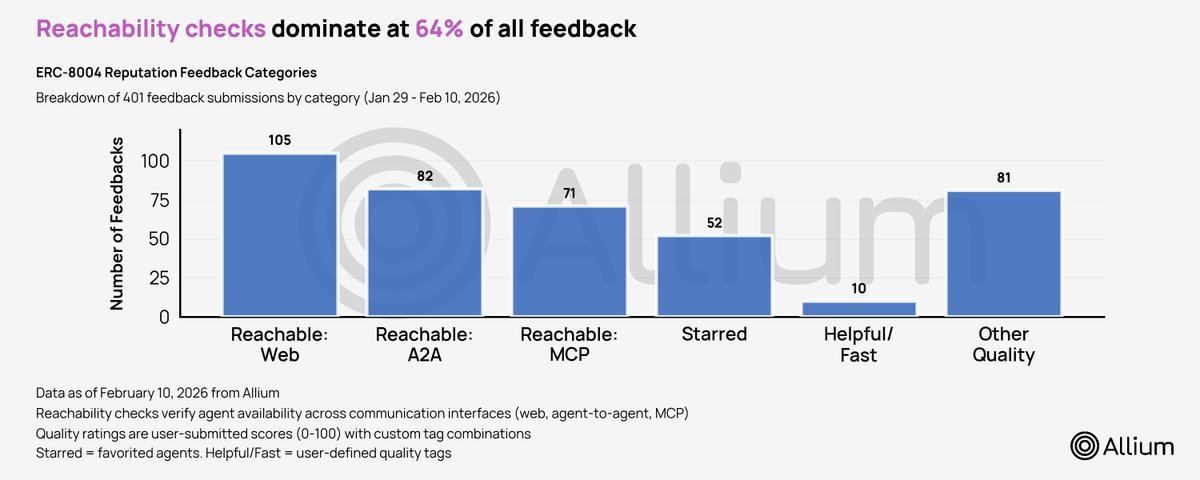
Most early feedback submissions were simple, but their existence demonstrates demand for a shared feedback primitive. The limiting factor is not interest but standardization, which is exactly the gap ERC-8004 fills.
As agent autonomy increases, reputation and validation shift from optional features to prerequisites. ERC-8004 provides the coordination layer that has to exist before more complex agent economies (automated procurement, delegated execution, agent-to-agent markets) can emerge.
ERC-8004 Use Cases
ERC-8004 enables foundational use cases for autonomous agents by standardizing how they are identified, evaluated, and verified onchain. Rather than prescribing specific applications, it provides shared primitives that agent developers and platforms build on across ecosystems.
Concrete examples include lending protocols checking an agent's reputation before extending credit, DAOs hiring agents for treasury proposals once their history of accurate financial reporting is validated, and agents offering different price levels for a task based on their reputation.
Agent Discovery and Coordination
ERC-8004 lets autonomous agents discover and identify each other without relying on centralized directories or proprietary platforms. Through the Identity Registry, each agent gets a persistent onchain identifier linked to metadata describing its capabilities, endpoints, and ownership.
This registry allows agents to:
- programmatically discover other agents
- evaluate whether another agent supports a required task or interface
- coordinate across organizational and chain boundaries
Who Is Building on ERC-8004
ERC-8004 is a standard, so its value depends on the tools and platforms that implement it. Several projects have moved to build on the three registries, and comparing them is the fastest way to understand how the standard shows up in practice.
| Project | Primary focus | What it does with ERC-8004 | Best fit for |
|---|---|---|---|
| Virtuals Protocol | Agent creation and monetization platform | Uses ERC-8004 identity to give agents portable, discoverable identities that carry reputation across the Virtuals ecosystem | Teams launching consumer-facing agents that need discoverability and a monetization path |
| Ensoul | Agent identity and trust framework | Focuses on the identity and reputation registries as a dedicated trust layer, emphasizing persistent agent profiles | Builders who want identity and reputation as first-class infrastructure rather than a platform add-on |
| Nevermined | Agent payments and behavior verification | Ties payment settlement to validation records so agents are paid only when verified behavior is confirmed | Agent-to-agent commerce where payment must depend on verified work |
| 8004scan | Registry lookup and exploration | Lets you inspect registered agents, their identity metadata, reputation, and validation records | Anyone auditing or researching agents registered under the standard |
Virtuals Protocol vs Ensoul for ERC-8004
Virtuals Protocol and Ensoul both use ERC-8004 identity, but they aim at different problems. Virtuals Protocol is a broad platform for creating and monetizing agents, and ERC-8004 identity is one layer inside a larger product that handles launch, distribution, and revenue. Ensoul is narrower and treats identity and reputation as the product itself, building a dedicated trust framework rather than a full agent marketplace.
The practical choice comes down to scope. If you want an end-to-end place to launch an agent and put it in front of users, Virtuals Protocol covers more of that path. If you want portable identity and reputation as standalone infrastructure that you can compose with your own stack, Ensoul is the closer match. Both write to the same ERC-8004 registries, so an agent's identity and reputation remain readable outside either platform.
8004scan and Exploring the Registries
Because ERC-8004 records live onchain, anyone can read them. Tools like 8004scan let you look up an agent by its identity, then trace the reputation and validation records attached to it. That is the plainest demonstration of what "portable" means: an agent's history does not depend on any single platform staying online, because the underlying registries are public.
For research, exploration through an 8004 scan tool is how you go from a claim ("this agent is trustworthy") to evidence (identity confirmed, reputation records present, validation attached).
How to Evaluate Identity Platforms for AI Agents
If you are choosing between identity platforms for AI agents, ERC-8004 gives you a useful checklist because it names the properties that matter. Evaluate any platform against these questions:
- Is the identity portable? Can an agent's identity be read outside the platform, or is it locked in a private database? ERC-8004 identities are onchain and readable by anyone.
- Is reputation persistent and tamper-evident? Can a bad actor wipe negative history and reappear clean, or is the record permanent and tied to identity?
- Is behavior verifiable? Does the platform support independent validation of what an agent actually did, or does it rely on self-reported claims?
- Is discovery permissionless? Can other agents and applications find and interact with an agent without going through a gatekeeper?
- Does it use open standards? Standards-based identity (like ERC-8004) means an agent is not stranded if one platform shuts down.
The strongest platforms score well on all five because they inherit those properties from the standard rather than reinventing them. When you compare options, hold each one against these criteria instead of feature lists, since the durability of an agent's identity is what protects your investment in it.
Where Onchain Agent Data Fits
ERC-8004 puts agent identity, reputation, and validation onchain, which means analyzing agent behavior at scale is a data problem. Reading three interoperable registries across many chains, joining them, and tracking how agent activity evolves requires reliable, standardized onchain data.
That is the layer Allium works on. Allium is the data foundation for onchain finance, ingesting raw data from 150+ blockchains and standardizing it into usable form delivered through databases, APIs, and data streams. The same standardized infrastructure that lets researchers track stablecoins, lending, and staking is what makes agent-level activity measurable as ERC-8004 adoption grows.
Frequently asked questions
What is the ERC-8004 Ethereum standard in simple terms?
ERC-8004 is an Ethereum standard that gives autonomous AI agents a shared trust layer. It uses three onchain registries (identity, reputation, and validation) so agents can prove who they are, carry a portable track record, and have their work independently verified. It is an application-layer standard built on existing Ethereum primitives, not a change to the protocol itself.
Is ERC-8004 a token?
No. ERC-8004 is a coordination and trust standard, not a token standard. It uses ERC-721 to mint a non-transferable identity NFT for each agent, but there is no fungible balance, no value transfer, and nothing to trade. The identity NFT exists only to anchor an agent's reputation and validation records.
How does ERC-8004 verify agent behavior?
Behavior verification in ERC-8004 combines all three registries. You resolve an agent's identity to confirm its wallet and metadata, read its onchain reputation to see how prior counterparties rated it, and require a validation record confirming the specific claimed action. The standard defines a common interface so multiple validation methods (cryptographic proofs, trusted execution environments, independent re-execution) can be used and compared.
What does Nevermined do with ERC-8004?
Nevermined builds payment and settlement infrastructure for AI agents. Its work on ERC-8004 ties agent payments to verifiable behavior, so an agent is paid only once a validation record confirms it did the work it claimed. That outcome is written back to the Reputation Registry, turning reputation into an enforced condition of getting paid rather than a passive score.
Virtuals Protocol vs Ensoul: which uses ERC-8004 better?
Both use ERC-8004 identity but target different problems. Virtuals Protocol is a broad platform for creating and monetizing agents, with identity as one layer inside a larger product. Ensoul is narrower and treats identity and reputation as the product itself, building a dedicated trust framework. Choose Virtuals Protocol for an end-to-end launch and monetization path, and Ensoul for portable identity and reputation as standalone infrastructure. Both write to the same public registries.
What is 8004scan?
8004scan is a registry lookup tool for ERC-8004. Because the standard's records live onchain, an 8004 scan lets you look up an agent by its identity and trace the reputation and validation records attached to it. It is the clearest way to move from a trust claim to onchain evidence.
How should I evaluate an identity platform for AI agents?
Check five properties: whether identity is portable and readable outside the platform, whether reputation is persistent and tamper-evident, whether behavior is independently verifiable, whether discovery is permissionless, and whether it uses open standards. Platforms built on ERC-8004 inherit these properties from the standard, which protects an agent's identity even if a single platform shuts down.
Why does ERC-8004 matter for the agent economy?
As AI agents interact directly with APIs, protocols, and other agents, the lack of shared identity, reputation, and verification is a structural bottleneck. ERC-8004 makes public agent discovery, portable reputation, and verifiable behavior possible at scale, which is the coordination layer that has to exist before more complex agent economies like automated procurement, delegated execution, and agent-to-agent markets can emerge.
Interested in learning more about Allium’s onchain data infrastructure? Speak to someone on the team.