Blockchain Accounting Software: 5 Platforms for 2026
Compare Allium, Cryptio, Bitwave, TRES Finance, and Lukka for crypto accounting and audit. We break down SOC certification, chain coverage, ERP integration, and what matters for closing books and passing audits.

Compare Allium, Cryptio, Bitwave, TRES Finance, and Lukka for crypto accounting and audit. We break down SOC certification, chain coverage, ERP integration, and what matters for closing books and passing audits.
Why Your Data Source Matters More Than Your Accounting Software
Finance teams evaluating crypto accounting platforms typically focus on features: transaction categorization, cost basis methods, ERP integration. These matter. But they are downstream of a more fundamental question: where does your data come from?
Every crypto accounting platform depends on blockchain data (the record of transactions written to a public ledger). Some build their own indexing infrastructure. Others pull from third-party providers, block explorers, or community sources. When auditors ask you to defend a number on your balance sheet, the answer cannot be "our software calculated it." You need to trace it back to source.
This comparison evaluates platforms across what accounting and finance teams actually need: SOC certification scope, data lineage for audit evidence, chain and protocol coverage, and how data gets delivered to your systems.
Cryptocurrency Software vs. Blockchain Software: Which Category Do You Need
People searching for crypto finance tools run into two overlapping categories that solve different problems. Getting the distinction right saves a procurement cycle.
Crypto accounting software (Cryptio, Bitwave, TRES Finance) provides the full workflow: import transactions, categorize them, calculate cost basis, sync to your ERP, generate reports. These are subledger solutions that sit between blockchain activity and your general ledger. If you want a system that closes your books, this is the category.
Blockchain data infrastructure (Allium, Lukka) provides the underlying data that powers accounting workflows. These platforms focus on data accuracy, completeness, and auditability. You can use them to power accounting software, build internal tooling, or query directly for reconciliation and audit. If you want control over the data layer and flexibility in how you use it, this is the category.
The practical difference is where the boundary sits. An accounting integration hands you finished journal entries inside a fixed workflow. A data platform hands you verified, normalized records you can route into any downstream system, including an accounting integration. Many teams use both: a subledger for the close, and a data platform underneath for reconciliation, audit evidence, and internal reporting that the subledger does not cover.
Platform Breakdown
Allium
Category: Blockchain data infrastructure
Best for: Finance teams that need SOC 2 attested data with flexibility to access it however works for their workflow
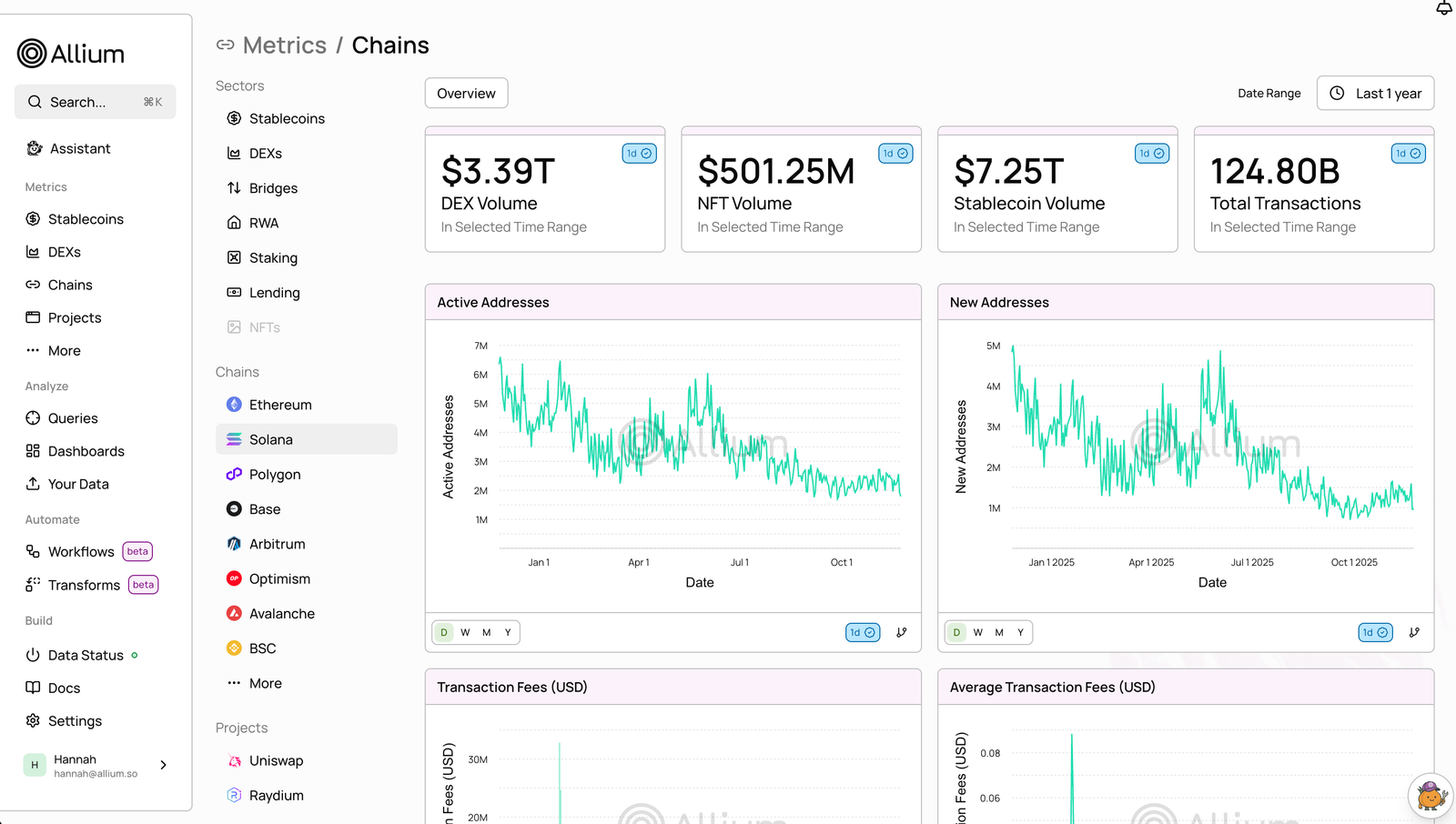
Allium provides blockchain data for accounting, audit, and compliance workflows. The platform does not replace your accounting software. It provides the verified data layer underneath it. Unlike traditional data infrastructure that requires heavy implementation, Allium is designed to plug into existing workflows: query directly in Allium's Explorer, connect via secure datashare to your data warehouse, or pull via API.
SOC Certification: covered by SOC 1 Type II and SOC 2 Type II reports. The report scope covers Allium's data pipelines (extraction, transformation, delivery). This distinction matters for audit: the process that produces your data is itself audited.
Chain and Protocol Coverage: 150+ chains, 1,000+ decoded protocols, 90M+ tokens. Coverage includes:
- Point-in-time balances (hourly/daily snapshots across chains)
- Transaction-time pricing for GAAP historical cost requirements
- Full DeFi position tracking: LP positions, lending, borrowing across major protocols
- Comprehensive staking data: validator rewards, delegation history, commission tracking
- Credit/debit schemas formatted for journal entries
Syncing large transaction volumes: High-volume treasuries and exchanges generate millions of transfers a month, and pulling them one API call at a time does not scale. To reconcile that activity, every transfer has to resolve to the same fields (asset, issuer, sender, recipient, amount, USD value at transaction time, and transaction type) across each chain a team touches. Allium normalizes those records across 150+ chains and delivers them as a secure datashare to Snowflake, Databricks, or BigQuery, so the full history lands in your warehouse and you reconcile against it with your own compute rather than paginating an API.
Keeping Pace with Change: Crypto accounting is a moving target. New chains launch, protocols upgrade, token standards evolve. Allium adds new chains in days and supported Hyperliquid from launch and handles protocol changes automatically. Your data models do not break when Uniswap launches a new version or a protocol migrates. For finance teams, this means less time chasing data gaps and more confidence that coverage stays current.
Data Delivery: Multiple access points depending on your workflow:
- Allium Explorer: Query and build reports directly in Allium's environment, no infrastructure setup required
- Secure Datashares: Blockchain data delivered to Snowflake, Databricks, or BigQuery. Query on your own compute, data stays in your environment, no vendor access to your queries
- APIs and Streams: REST APIs for application integration, Kafka/PubSub/SNS for real-time workflows
Proof points: Allium data has been cited by the Federal Reserve in research and powered Visa's stablecoin dashboard and a16z's State of Crypto report.
Pricing: Enterprise; contact for quote.
Considerations: Allium is data infrastructure, not a turnkey subledger with built-in categorization and ERP sync. Teams wanting one-click journal entry generation may pair Allium with accounting software or use it to power internal processes. For a worked example of building on this layer, see how Awaken built crypto tax software for protocol-level complexity.
Cryptio
Category: Crypto accounting software
Best for: Enterprises with traditional finance requirements and existing ERP systems
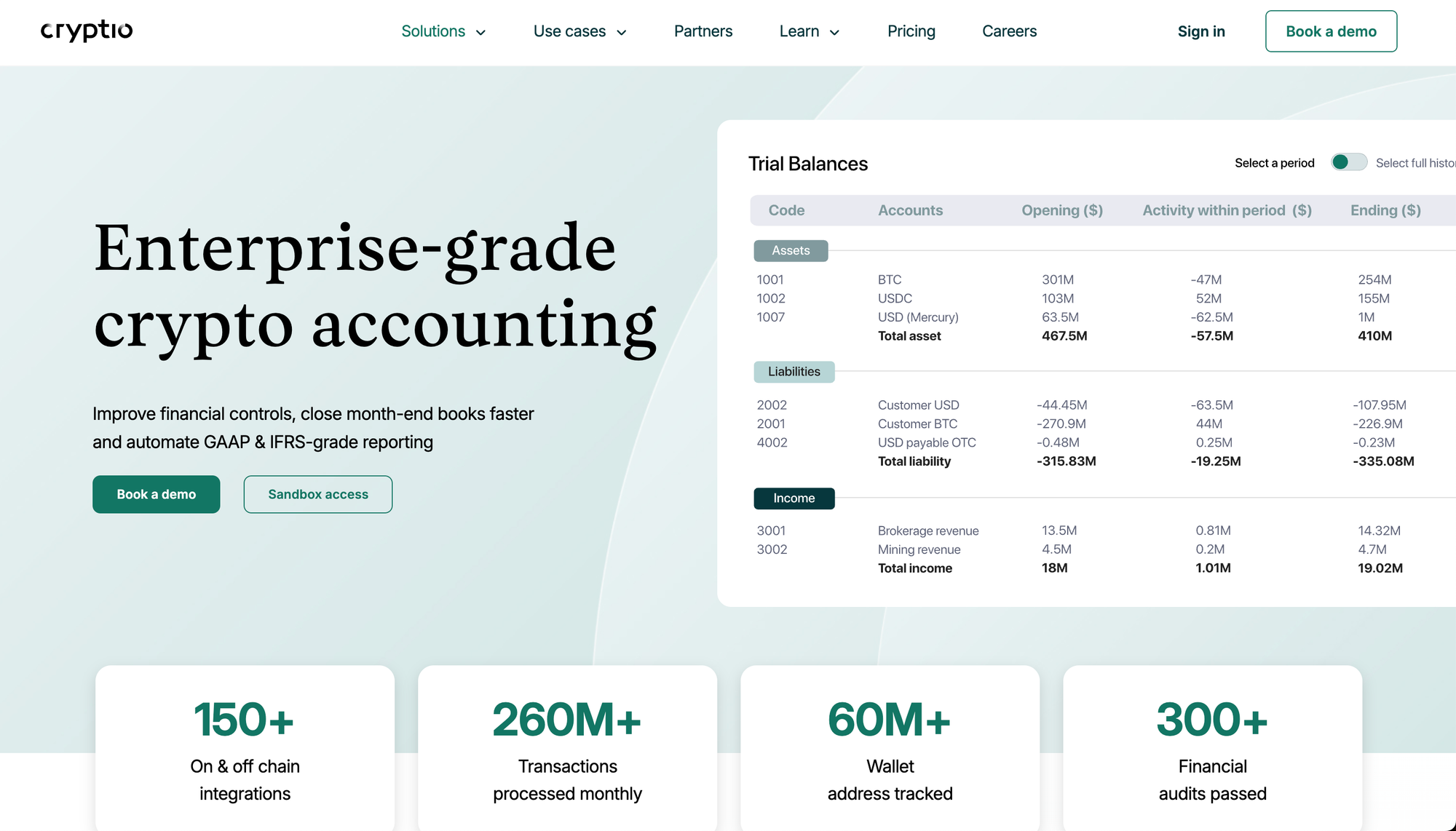
Cryptio is an accounting platform built for institutions that need audit-ready reporting and integration with mainstream accounting systems.
SOC Certification: As published by the vendor; confirm current scope and report date.
Chain and Protocol Coverage: 12+ blockchains including Ethereum, BSC, Polygon. Integrates with major exchanges (Coinbase, Kraken, Bitfinex) and custodians. Supports basic DeFi and staking data, though protocol coverage is less extensive than DeFi-focused platforms.
Data Delivery: Cloud platform with native ERP integrations (QuickBooks, Xero, NetSuite). Transaction data synced automatically; reports exportable for audit.
Key Features:
- GAAP and IFRS-compliant reporting
- Automated cost basis tracking (FIFO, LIFO, specific identification)
- IRS and SEC-compliant report generation
- Intangible impairment tracking per ASC 350
- Smart Contract Engine for transaction categorization
Pricing: Plan tiers are published by the vendor; the higher tier adds DeFi/NFT tracking, GAAP/IFRS historical reporting module, and dedicated account manager.
Considerations: Coverage focuses on established chains. Initial setup may require accounting expertise to configure properly. Best suited for teams with moderate DeFi exposure.
Bitwave
Category: Crypto accounting software plus payments
Best for: Finance teams that need accounting and crypto payment workflows in one platform
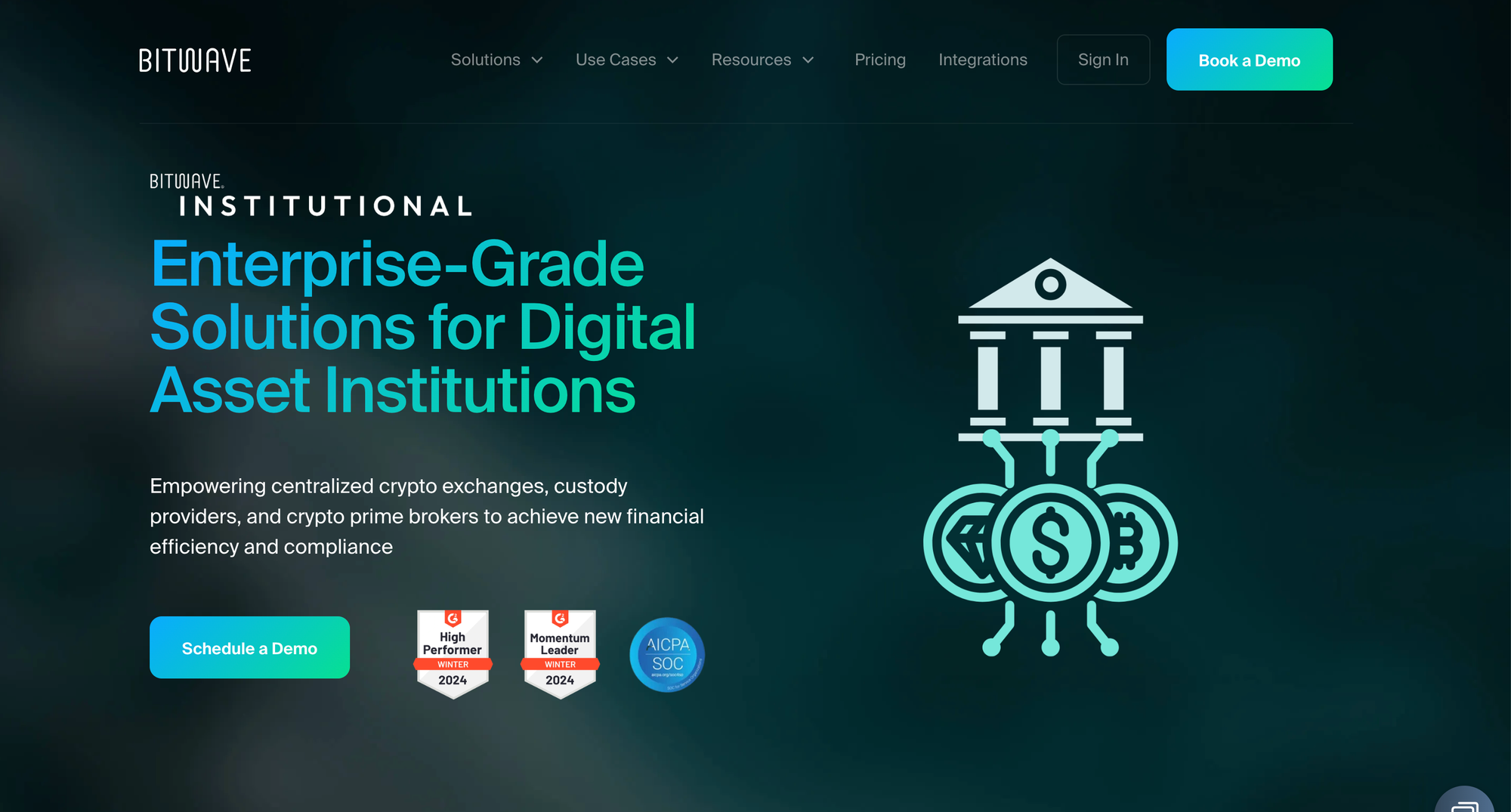
Bitwave combines accounting functionality with AR/AP capabilities, positioning itself as a complete digital asset finance platform rather than just a subledger.
SOC Certification: As published by the vendor; confirm current scope and report date.
Chain and Protocol Coverage: 50+ blockchains and protocols. Custom "Data Fusion" service for additional data sources. Integrations with major exchanges and custodians.
Data Delivery: Cloud platform with ERP integrations (NetSuite, QuickBooks, Sage Intacct, Xero). API available for custom workflows.
Key Features:
- GAAP/IFRS-compliant reporting with fair value accounting
- Stablecoin invoicing and bill pay (AR/AP)
- DeFi dashboard with point-in-time position tracking
- Automated transaction categorization with rules engine
- Internal transfer detection
Pricing: Not published; requires quote.
Considerations: Strong on integrated payment workflows.
TRES Finance
Category: Crypto accounting software
Best for: Organizations with significant DeFi and staking activity
TRES Finance is built on what they call a Financial Data Lake, infrastructure that aggregates data from blockchains, exchanges, and custodians into a unified source. The platform emphasizes breadth of DeFi coverage.
SOC Certification: As published by the vendor; confirm current scope and report date.
Chain and Protocol Coverage: 200+ blockchains, major exchanges (Coinbase, Binance), leading custodians. Claims widest coverage in market. 120+ DeFi protocols with staking reward tracking across validators.
Data Delivery: Cloud platform with ERP integrations (NetSuite, QuickBooks). Bank connectivity for fiat on/off-ramp tracking.
Key Features:
- Triple data verification with automated reconciliation
- AI-driven transaction categorization
- GAAP/IFRS reporting with multiple cost basis methods
- Spam transaction filtering and anomaly detection
- CPA support included for all customers
Pricing: Not published; enterprise pricing.
Considerations: Comprehensive DeFi coverage is a strength. Platform configuration may benefit from expert guidance for complex setups.
Lukka
Category: Blockchain data infrastructure
Best for: Fund administrators, institutional investors, and accounting firms
Lukka has operated since 2014, focused on institutional-grade data and software for middle and back-office operations. Strong presence with fund service providers and large accounting practices.
SOC Certification: As published by the vendor; confirm current scope and report date. Also holds ISO/IEC-27001 certification and completed NIST Cybersecurity Assessment.
Chain and Protocol Coverage: 50+ blockchains and exchanges. Reference data for 1M+ crypto assets. Supports major custodians. DeFi and staking coverage described as basic.
Data Delivery: Enterprise Data Management SaaS. Integrations with fund administration platforms. Partnered with SoftLedger for a combined accounting solution.
Key Features:
- Automated bulk reconciliation with audit trails
- Fair Market Value pricing aligned to GAAP/IFRS guidelines
- Reference Data products for asset classification and security master
- NAV reporting support for fund administrators
- Benchmark and index data services
Pricing: Enterprise; contact for quote.
Considerations: Lukka is data infrastructure and fund services, not end-to-end accounting software. DeFi protocol coverage is limited compared to DeFi-focused platforms. Best suited for institutional use cases with traditional fund structures.
Comparison Table
| Allium | Cryptio | Bitwave | TRES Finance | Lukka | |
|---|---|---|---|---|---|
| Type | Data infrastructure | Accounting software | Accounting + Payments | Accounting software | Data infrastructure |
| SOC 1 report (per vendor) | Type I & II | Type 1 & 2 | Type I | Type 2 | Type II |
| SOC 2 report (per vendor) | Type I & II | Type 1 & 2 | Type I | Type 2 | Type II |
| Additional Certifications | — | — | — | — | ISO 27001, NIST |
| Chain Coverage | 150+ | Not published | Not published | Not published | Not published |
| Protocol Coverage | 1,000+ | Not published | Not published | Not published | Not published |
| DeFi Position Tracking | Full (LP, lending, borrowing) | Basic | Yes | Yes | Basic |
| Staking Data | Comprehensive (rewards, validators, delegations) | Basic | Yes | Yes | Basic |
| Speed to New Chains | Days; supported Hyperliquid from launch | Not published | Varies | Varies | Not published |
| Point-in-Time Balances | ✓ | ✓ | ✓ | ✓ | ✓ |
| Transaction-Time Pricing | ✓ | ✓ | ✓ | ✓ | ✓ |
| Access Options | Explorer, Datashares, APIs, Streams | Cloud platform | Cloud platform | Cloud platform | Enterprise SaaS |
| Query on Own Compute | ✓ (Snowflake/Databricks/BigQuery) | — | — | — | — |
| Native ERP Integration | — | ✓ | ✓ | ✓ | — |
| AR/AP & Payments | — | — | ✓ | — | — |
| Best For | Flexible, attested data for enterprise teams and use cases | Traditional enterprise accounting | Accounting + payment workflows | DeFi-heavy organizations | Institutional finance teams |
Audit and Reconciliation Tooling for Finance Teams
The hardest part of a crypto close is not categorization. It is reconciliation: proving that your internal records match what actually happened onchain, transaction by transaction, and being able to show an auditor where each figure came from. Wallet balances, exchange statements, and custodian reports all have to agree with the ledger, and any gap has to be explained.
Accounting software handles this inside its own workflow. Data infrastructure supports it differently, by giving finance teams the raw, verified records to reconcile against and a documented lineage from block to balance sheet. For a deeper treatment of the methods and system design behind this, see onchain data reconciliation for accounting.
Choosing the Right Platform
Choose Allium if: You need SOC 2 attested data pipelines with flexibility in how you access them, whether querying directly in Allium's Explorer, connecting via secure datashare to your own data warehouse, or pulling via API. Best for teams that want comprehensive DeFi and staking coverage, need to sync large transaction volumes into their own environment, or require verified data lineage for audit.
Choose Cryptio if: You want turnkey accounting software with strong audit trail capabilities, GAAP/IFRS compliance, and native ERP integration. Best for enterprises with established finance processes and moderate blockchain complexity.
Choose Bitwave if: You need accounting and payment workflows together, including crypto invoicing, AR/AP, and stablecoin payments alongside your subledger.
Choose TRES Finance if: You have significant DeFi and staking activity and need comprehensive protocol coverage with SOC 2 Type 2 certification.
Choose Lukka if: You are a fund administrator, institutional investor, or accounting firm needing audit-aligned data infrastructure with deep compliance credentials.
Interested in learning more about Allium's onchain data infrastructure? Speak to someone on the team.
Updated 24 September 2026: vendor comparison revised. Comparative attributes are taken from each vendor's own published material; cells marked "Not published" mean the vendor does not state it publicly.
Allium provides onchain data infrastructure. Companies named in this article may be Allium customers, prospects or commercial counterparties. This article is informational only and is not investment, legal or tax advice. Data and information last reviewed: September 24, 2026.
Frequently asked questions
What is the difference between a SOC Type I and a Type II report?
Type I validates that controls are designed appropriately at a specific point in time. Type II validates that controls operated effectively over an extended period (minimum 6 months for SOC 1). Type II provides stronger audit assurance because it demonstrates sustained operational effectiveness, not just a snapshot.
What does it mean when SOC certification covers "pipelines" vs. the application?
Certifying data pipelines means the extraction, transformation, and delivery processes are also audited. This matters because your financial data is only as reliable as the process that produced it.
What's a secure datashare and why does it matter?
A secure datashare delivers data directly to your data warehouse (Snowflake, Databricks, BigQuery) without API calls or data transfer. You query on your own compute infrastructure. Benefits: no vendor access to your queries, no data leaving your environment, and simplified vendor risk assessment for auditors.
Which crypto accounting solutions sync large transaction volumes?
High-volume treasuries and exchanges generate millions of transfers a month, which is difficult to pull one API call at a time. Platforms that deliver full transaction history as a datashare to your own warehouse (such as Allium into Snowflake, Databricks, or BigQuery) let you reconcile at scale with your own compute rather than paginating an API. Accounting software syncs volume through automated exchange and wallet connections into its own subledger.
How do I know my data source will keep up with new chains and protocols?
Crypto moves fast: new chains launch, protocols upgrade, token standards evolve. Ask providers how quickly they add new chains, what happens when a protocol changes, and whether updates are automatic or require a request. Onboarding speed for a new chain varies by vendor; Allium adds new chains in days and handle protocol changes automatically without breaking existing queries.
Which platform is best for GAAP/IFRS compliance?
All platforms listed support GAAP and IFRS reporting. Key differentiators: transaction-time pricing (required for GAAP historical cost), fair value measurement capabilities, and intangible impairment tracking per ASC 350/ASU 2023-08.
What blockchain data do auditors typically request?
Common audit evidence requests include complete transaction history with timestamps, fair market value at transaction time, wallet ownership verification, reconciliation between internal records and onchain data, and data lineage showing the source of reported figures.
What's the difference between blockchain data infrastructure and accounting software?
Accounting software provides workflows: categorization, cost basis calculation, ERP sync, report generation. Blockchain data infrastructure provides the underlying blockchain data. Some data infrastructure requires heavy implementation; others (like Allium) offer multiple access points, from a hosted Explorer for quick queries to secure datashares for enterprise data governance.
Do I need both data infrastructure and accounting software?
It depends on your requirements. Accounting software (Cryptio, Bitwave, TRES) includes data collection and is sufficient for many teams. Dedicated data infrastructure makes sense if you need data delivered to your own environment, verified data lineage for strict audits, comprehensive DeFi and staking coverage, flexibility to power multiple downstream systems, or confidence that coverage keeps pace as crypto evolves.
How should I think about pricing?
Some vendors publish list pricing and others quote; check each vendor's own page. Factors affecting price include transaction volume, number of wallets/entities, chain coverage needed, support level, and delivery method. Data infrastructure pricing typically scales with query volume and data delivery method.