The Future of Blockchain Analytics Doesn't Require SQL

Key takeaways:
- Blockchain data analytics used to require highly-specialized knowledge to navigate
- MCP now changes complex data retrieval into natural conversation
- SQL isn’t replaced by MCP, but MCP gives AI agents the ability to use SQL, APIs and other tools
- MCP lowers the barrier to entry for all blockchain data analytics
Model Context Protocol, or MCP, is an open standard that allows AI agents to interact with external tools and data sources. In blockchain analytics, MCP lets users query data through natural language instead of manually using APIs and SQL queries.
Structured Query Language, or SQL, is a query language used to retrieve, combine, and compute data from structured databases.
When people think about blockchain analytics, they often assume the biggest barrier is SQL. It isn't.
The real challenge is knowing where to look in the first place. Before a single query gets written, users need to identify the right datasets, understand schema relationships, navigate protocol-specific nuances, and determine which data sources actually contain the answer they're looking for.
This complexity has kept blockchain analytics largely in the hands of engineers and data analysts.
Model Context Protocol (MCP) changes that. Instead of forcing users to navigate documentation, schemas, APIs, and query languages themselves, MCP allows AI agents to discover and retrieve information on their behalf.
The result is not a world without SQL. It's a world where users can start with a question instead of a database.
Why Answering Simple Blockchain Questions Isn't Simple
Many blockchain questions seem straightforward. Finding the answer is often much harder.
Take these questions (many of which could be relevant to financial institutions, crypto-native platforms, or anyone building on blockchain):
- How much USDC moved through Base last month?
- Which stablecoins are growing fastest across payment networks?
- Which exchanges hold the largest share of circulating USDC?
- How has tokenized treasury activity changed over the past quarter?
The challenge to answering these questions isn’t necessarily writing the SQL, but knowing all of that aforementioned prior information: which chain-specific tables should be used? How is the token metadata represented? Do we need to use historical records or real-time feeds?
Blockchain analytics has therefore remained concentrated among engineers and analysts. Because even though the data is open and transparent, it requires a highly specialized knowledge to actually use it. But as blockchain adoption expands, many of the people who now need data answers aren’t database experts — nor should they be.
Model Context Protocol (MCP) changes the relationship between users and blockchain data. Instead of navigating databases before asking questions, MCP allows AI systems to discover the documentation needed and retrieve blockchain data through natural language alone.
MCP Turns Data Discovery Into Conversation
The biggest misconception about blockchain analytics is that SQL is the bottleneck.
In reality, most of the work happens before the query is written. Analysts spend time finding the right datasets, understanding how protocols are represented, validating assumptions, and determining which schemas contain the information they need.
MCP automates much of that discovery process. Instead of navigating infrastructure first and asking questions second, users can begin with the question itself.
Instead of starting with database explorers or API references, MCP allows users to now start with the question itself. Their AI agent can then search the documentation and generate the appropriate queries behind the scenes.
Documentation Becomes Searchable
With MCP, documentation simply becomes part of the conversation. Rather than manually browsing pages to find the correct endpoints, users can ask questions in natural language.
Examples of questions that can direct an AI agent to search through documentation are your behalf are below:
- How do I retrieve historical wallet balances?
- What datasets are available for stablecoin transfers?
- Which chains support DeFi position tracking?
The AI then searches the documentation and brings you the relevant information, reducing your time spent on any manual searching. This also greatly reduces the barrier to entry, since a user doesn’t need to have a deep understanding of the documentation behind historical wallets, for example.
Where Does SQl Fit Into MCP Queries?
MCP does not replace SQL.
Instead, it makes SQL accessible to people who would never learn it.
When a user asks a question through MCP, an AI agent can determine which datasets are relevant, generate the appropriate SQL, execute the query, and return the result. The user receives the answer without needing to understand the underlying database structure.
SQL remains critical to the process. MCP simply changes who can benefit from it.
Going back to our first example question — How much USDC was transferred on Base last month? — an MCP workflow might look like this:
- Question
- Discover relevant documentation
- Identify the right dataset
- Generate the query
- Retrieve the data
- Return the answer
As the user, you don’t see results 1-5 (and therefore don’t need to use SQL). But SQL is still integral to the fact-finding process conducted by the agent.
Accessibility Does Not Mean Losing Transparency
One criticism of AI-powered analytics is that it can turn data retrieval into a black box. If users no longer directly interact with databases, how can they trust the results? While that’s a legitimate concern, users can still understand how answers were generated with AI — they just need to ask.
The Best Systems Still Expose the Underlying Logic
Natural language should simplify access to data, not hide methodology.
Users should still be able to understand which datasets were used, how information was retrieved, and what assumptions influenced the final result. When necessary, analysts should be able to inspect the generated query, review the source data, and validate the reasoning process.
Reliable Answers Still Depend on Reliable Data
MCP improves the interface between users and data, but it does not solve underlying data quality problems.
Accurate analytics still depend on consistent schemas, reliable indexing, normalized datasets, and transparent methodologies. If the underlying data is incomplete or inconsistent, natural-language access simply makes those problems easier to surface.
This is why data infrastructure remains critical even as AI becomes the primary interface. Better conversations can help users find answers faster, but trustworthy answers still require trustworthy data underneath them.
What MCP Unlocks for Non-Technical Blockchain Data Teams
How Allium MCP Connects AI to Blockchain Data
Natural-language access to blockchain data only works when AI can reliably find, understand, and retrieve information from the correct source.
Without that foundation, users simply replace database complexity with AI hallucinations.
Allium's MCP implementation gives AI agents structured access to blockchain data, documentation, schemas, analytics workflows, and real-time information. Instead of manually navigating those systems, users can begin with a question while the agent handles the discovery and analysis behind the scenes.
Documentation Discovery
One of the biggest challenges for both humans and AI systems is understanding what data exists in the first place.
Allium MCP includes documentation tools that allow agents to search the Allium documentation directly. Instead of manually browsing reference pages, users can ask questions such as:
- How do I retrieve wallet holdings?
- What datasets are available for stablecoin transfers?
- How do I access DeFi positions?
The agent can search the documentation and surface relevant guidance before analysis even begins.
Schema Discovery and Exploration
Agents need to understand how data is organized, not just where it exists.
Allium MCP allows agents to inspect available schemas and identify relevant datasets before generating queries. Rather than memorizing table names or manually exploring database structures, users can begin with the question they want answered.
For example:
- What tables contain stablecoin transfer activity on Base?
- Where can I find wallet balance data?
The agent can then identify relevant schemas and dataset structures automatically.
Explorer Query Access
Many organizations already have analytics workflows built around saved queries and existing research. Through MCP, agents can access and execute Explorer queries directly. This allows users to leverage prebuilt analytics rather than recreating every workflow from scratch.
One example from Allium’s documentation is using MCP to retrieve existing analytics and execute saved Explorer historical data queries directly through natural-language instructions.
This is particularly useful for teams that already have reporting and analytics processes built inside Allium Explorer.
Real-Time Blockchain Data Access
Many blockchain questions also require current information, not just historical snapshots.
Allium MCP includes real-time tools that allow agents to retrieve live blockchain information through the same conversational interface used for analytics and research.
For example, users can ask the below without manually interacting with APIs:
- What is the current balance of this wallet?
- What are the latest transfers involving this address?
This enables AI workflows that combine historical analysis with live blockchain activity.
One Interface for Data Discovery and Analysis
The most important capability is the ability to combine tools. Allium’s MCP tools allow agents to move between documentation search, schema exploration, query generation, and data retrieval within the same workflow. A user can begin with a business question, discover the relevant dataset, execute the analysis, and retrieve results without manually switching between documentation pages, APIs, schema browsers, and query editors.
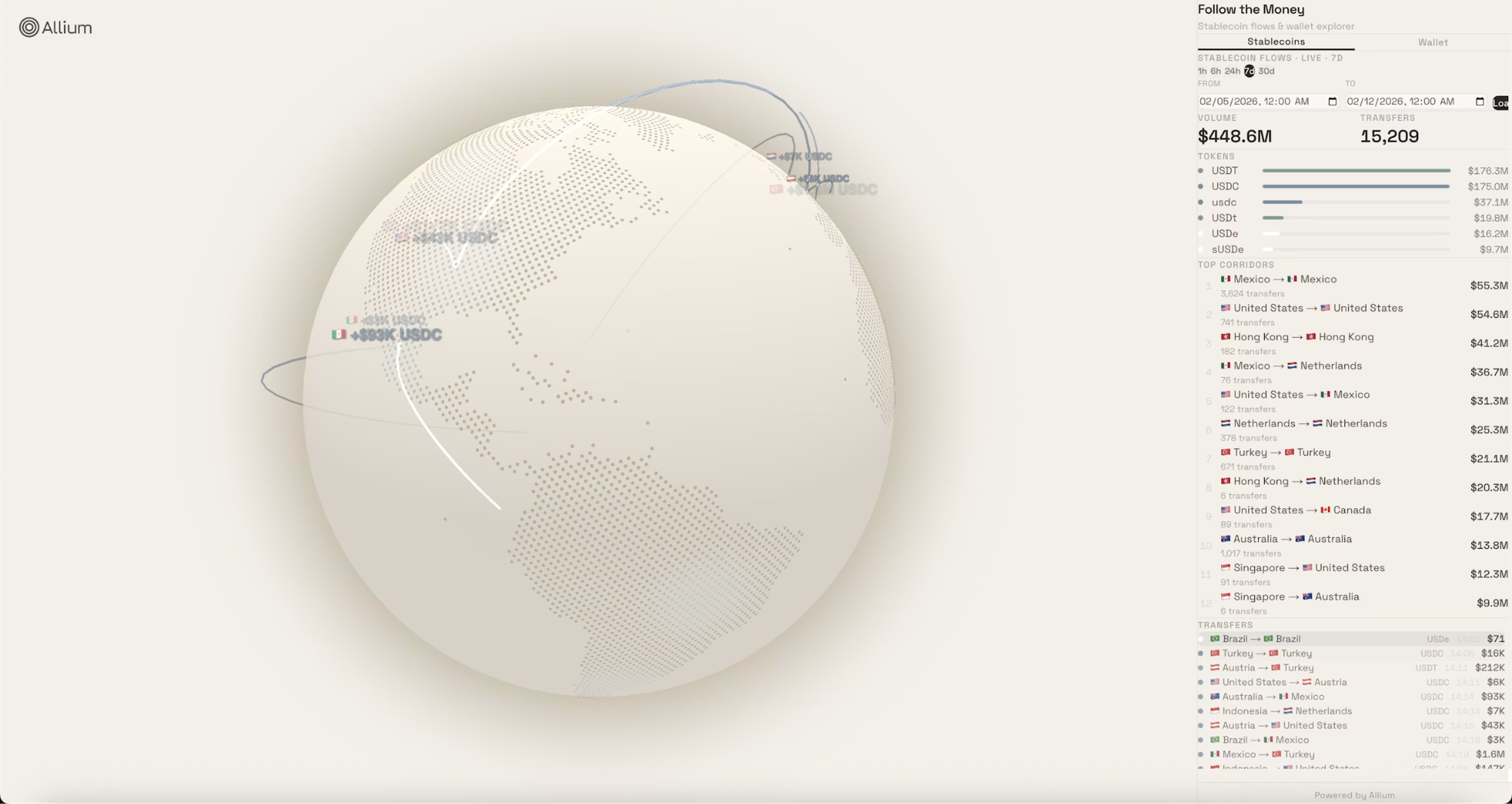
Allium’s MCP allows teams to build products simply and quickly that otherwise would take larger teams significantly more time.
One example: this interactive 3D map visualizes real-time stablecoin transfers, and was built in just a few hours with Allium MCP and Claude Code.
FAQs About MCP and Blockchain Data Accessibility
Does MCP replace SQL?
No, MCP does not replace SQL. SQL remains the underlying query layer. MCP changes how users access it.
What problems does MCP solve?
MCP reduces the need to manually discover documentation, schemas, APIs, and query structures before accessing data.
Can non-technical teams use blockchain analytics through MCP?
Yes, that’s the whole point. Product, operations, compliance, research, and strategy teams can access blockchain insights without deep database expertise.
How does MCP know which data to query?
Allium MCP includes schema discovery and documentation search tools that help agents identify relevant datasets before executing queries.
Can MCP access real-time blockchain data?
Yes, MCP can access real-time blockchain data. Allium MCP includes tools for retrieving real-time blockchain information in addition to historical analytics.
Blockchain Data Should Not Require Database Expertise
Blockchain data has always been public. The challenge has been making it usable.
For years, extracting meaningful insights required specialized knowledge of schemas, protocols, APIs, and query languages. MCP changes that by allowing users to interact with blockchain data through conversation rather than infrastructure.
The result isn't just faster analytics. It's a future where product teams, researchers, compliance teams, strategists, and institutions can all access blockchain insights without needing to become blockchain data experts first.