
Onchain AI Identity: What ERC-8004 Unlocks for Agent Infrastructure


ERC-8004 is a standard that aims to solve the problem — how can different AI agents trust each other?
As more apps are being built entirely without human intervention, AI agents are able to do almost everything needed to execute successfully: ideate, create, purchase, and build. However, while a human is able to vet a potential client with references or reviews, an AI agent doesn’t inherently have the same reasoning capability.
In simplest terms, ERC-8004, or “Trustless Agents,” is an Ethereum standard that creates a trust layer that allows AI agents to work together based on identity, reputation and validation.
Agents are already able to speak to each other via communication protocols like A2A and MCP. ERC-8004 adds a needed level of trust and accountability to the conversation.
What Is ERC-8004?
ERC-8004 is an Ethereum standard that creates a trust layer for autonomous AI agents through identity, reputation, and validation registries.
First proposed in August 2025, the standard was created by a team made up of contributors from MetaMask, the Ethereum Foundation, Google and Coinbase.
ERC-8004 is not a token standard like ERC-20, ERC-721, or ERC-155. These familiar standards define assets: they specific balances or economic value. ERC-8004 is not a fungible token, it cannot be traded, and it does not represent any value.
It’s an important distinction — while ERC-8004 actually uses NFTs like ERC-721 to internally represent agent identities, the standard itself is about coordination and trust, not value transfer.
The goal behind creating ERC-8004 is to make agents discoverable and accountable across networks, enabling permissionless coordination between AI systems, APIs, and other machine actors without relying on centralized trust intermediaries.
How ERC-8004 Architecture Works
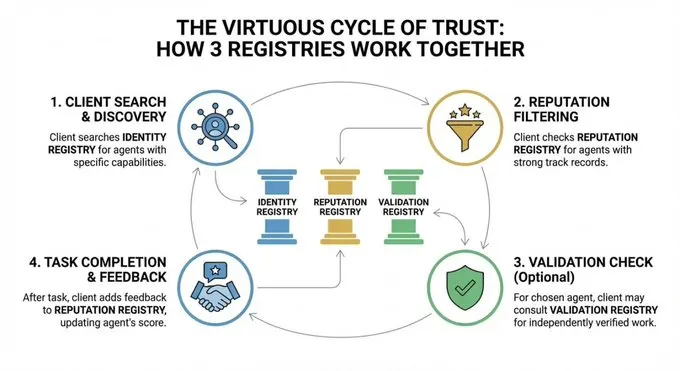
ERC-8004 works by defining three interoperable onchain registries that together enable public discovery, reputation, and verification for autonomous agents.
The ERC-8004 standard defines three distinct registries — Identity, Reputation, and Validation — that together allow agents to discover each other, evaluate trustworthiness, and verify claimed actions.
Source: Marcello Politi, Medium
Identity Registry
The Identity Registry does what its name suggests: it creates a global directory of AI agents, assigning each agent an onchain identity via ERC-721. This identity is linked to metadata such as the agent’s name, description, supported endpoints, wallet addresses, and other identifiers, allowing other agents and systems to programmatically discover and interact with it.
Reputation Registry
The Reputation Registry standardizes how feedback about agents is recorded onchain. It serves as a persistent, queryable history of ratings and evaluations submitted by clients or other agents after interactions.
By making reputation data public and composable, the registry allows agents and applications to incorporate trust signals — such as past performance or reliability — into their decision-making processes.
Validation Registry
The Validation Registry standardizes how agent actions are independently verified onchain. It is the part of ERC-8004 that addresses a simple question: how do you know an agent actually did what it claims to have done?
Where the Identity Registry answers who an agent is, and the Reputation Registry records what others say about it, the Validation Registry provides a standardized way to attach verifiable evidence to an agent’s actions.
At a high level, the Validation Registry defines:
- How validation providers are registered
- How validation results are referenced onchain
- How third parties can verify agent outputs without trusting the agent itself
Importantly, ERC-8004 does not mandate a single validation technique; it defines a common interface so multiple validation mechanisms can coexist and be compared.
Why ERC-8004 Matters
As AI agents become autonomous and interact directly with APIs, protocols, and other agents, the lack of a shared system for identity, reputation, and verification becomes a structural bottleneck. Without standardized infrastructure, agents are difficult to discover, impossible to compare, and costly to trust.
As Allium research Elton writes, there is no dominant agency currently tracking agent behavior — but the demand is more than there.
A multi-million dollar Super Bowl ad for AI.com (a website where users can reserve their AI handles), almost immediately crashed the site. And the domain itself was purchased for $70 million by Crypto.com’s Kris Marszalek. These moments are not about speculation; they signal that identity at the agent level is becoming economically and operationally meaningful, even before the underlying infrastructure exists to support it.
ERC-8004 matters because it makes three things possible at scale:
- Public agent discovery without centralized directories
- Portable reputation that persists across applications and ecosystems
- Verifiable agent behavior without relying on offchain trust.
According to Allium research, the first two weeks after ERC-8004’s launch brought in 401 feedback submissions on autonomous AI agents.
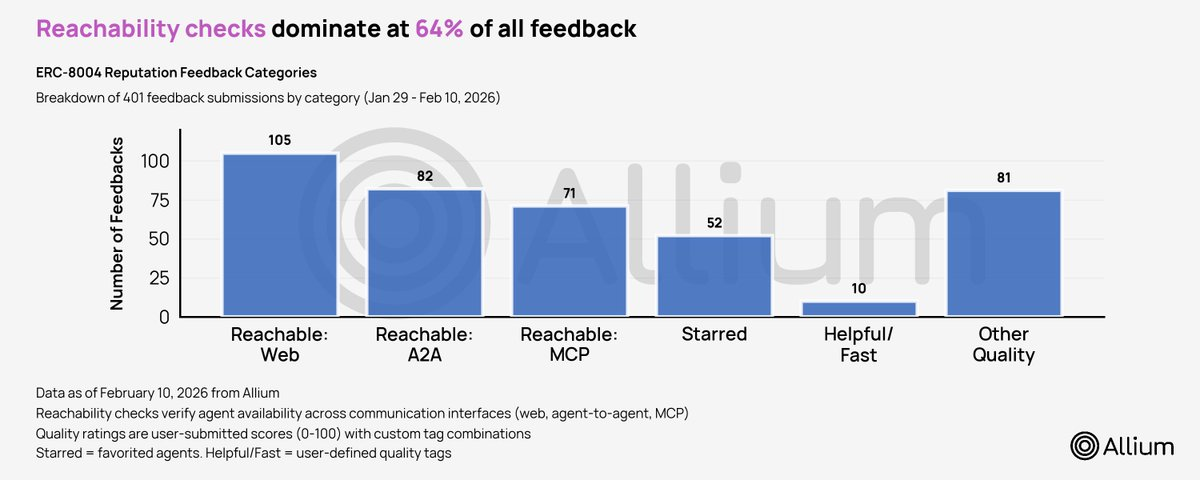
While most early feedback submissions were simple, their existence demonstrates demand for a shared feedback primitive. The limiting factor today is not interest, but standardization — exactly the gap ERC-8004 is designed to fill.
As agent autonomy increases, reputation and validation will become prerequisites rather than optional features. ERC-8004 provides the coordination layer needed before more complex agent economies — such as automated procurement, delegated execution, or agent-to-agent markets — can emerge.
ERC-8004 Use Cases
ERC-8004 enables a set of foundational use cases for autonomous agents by standardizing how they are identified, evaluated, and verified onchain. Rather than prescribing specific applications, the standard provides shared primitives that agent developers and platforms can build on across ecosystems.
Some simple examples of real world use cases for ERC-8004 could be lending protocols checking an agent’s reputation before extending credit, DAOs hiring agents for treasury proposals once their history of producing correct financial reporters was validated, and agents offering different price levels for execution of tasks based on their reputation.
Agent Discovery and Coordination
ERC-8004 enables autonomous agents to discover and identify each other without relying on centralized directories or proprietary platforms. Through the Identity Registry, each agent is assigned a persistent onchain identifier linked to metadata describing its capabilities, endpoints, and ownership.
This registry allows agents to:
- programmatically discover other agents
- evaluate whether another agent supports a required task or interface
- coordinate across organizational and chain boundaries using shared identifiers.
As agent ecosystems scale, this form of public, permissionless discovery becomes a prerequisite for agent-to-agent collaboration.
Reputation-Based Agent Selection
The Reputation Registry allows agents and applications to incorporate historical performance into decision-making. After an interaction, clients or peer autonomous AI agents can submit structured feedback tied to an agent’s onchain identity.
In practice, this enables:
- comparing agents based on past reliability or task outcomes
- filtering or ranking agents using composable reputation signals
- reducing reliance on pre-established trust relationships.
Rather than treating all agents as interchangeable, ERC-8004 makes trust an explicit, queryable input into agent selection. An agent with a poor reputation will become less likely to be picked for a task by another autonomous agent.
Verifiable Agent Execution
For higher-stakes interactions, reputation alone is insufficient. ERC-8004’s Validation Registry supports use cases where agent actions must be independently verified.
By referencing validation proofs onchain, agents and systems can:
- confirm that a task was executed as claimed
- evaluate the strength of different validation methods
- enforce higher assurance requirements for sensitive operations.
This enables autonomous workflows where trust is based on verifiable evidence rather than assumptions, making ERC-8004 suitable for use cases involving financial actions, delegated execution, or compliance-sensitive tasks.
ERC-8004 Integrations and Tools
ERC-8004 is supported by a growing set of developer tools and platform integrations that make its registries usable in practice.
Tools like 8004Scan aggregate ERC-8004 Identity, Reputation, and Validation data into a queryable interface, making it easier for developers and researchers to track agent activity onchain. Agent frameworks can reference the standard directly to register agents and surface trust signals.
These integrations also enable analytics and composability with adjacent protocols, allowing developers to build interoperable agent ecosystems without managing trust infrastructure offchain.
Common ERC-8004 Misconceptions and Risks
ERC-8004 is often misunderstood as a token standard or payment system, but it defines only identity, reputation, and validation registries for autonomous agents. Risks include over-relying on reputation without validation, assuming cross-platform portability where frameworks are not yet integrated, and underestimating the potential for inaccurate or incomplete feedback submissions.
By understanding these limitations and the scope of the standard, developers and users can apply ERC-8004 effectively while mitigating common pitfalls.
FAQs About ERC-8004
What is ERC-8004 used for?
ERC-8004 is used for creating trust between autonomous AI agents. AI agents are already able to communicate with each other using existing protocols — the ERC-8004 standard adds in a public discovery layer of trust. With the use of three registries (Identity, Reputation, Verification), AI agents are able to identify themselves, have a permanent record of client feedback and ratings, and independently verify agent actions.
Is ERC-8004 a crypto token?
No, ERC-8004 is not a crypto token. Unlike token standards like ERC-721, ERC-8004 does not store any economic value. Instead, the standard itself is about coordination and trust.
Does ERC-8004 handle agent payments?
No, ERC-8004 does not handle agent payments. Payments must be handled separate by other standards or rails, like x402, ERC-20 or ERC-4337.
Is ERC-8004 compatible with non-EVM?
No, ERC-8004 is designed for EVM-compatible chains. However, non-EVM systems can access its data through bridges or adapters, even though the standard itself runs only on EVM smart contracts.
The Future of ERC-8004
Looking ahead, combining ERC-8004’s trust layer with protocols like x402 for agent payments could enable complex autonomous agent marketplaces where identity, reputation, verification, and settlement are all onchain.
x402 helped complete the missing piece of adding programmatic payments to the internet. ERC-8004 has now added the ability for AI agents to trust one another. Taken together, they can unlock the foundation for decentralized agent economies.


