How Allium Terminal Identifies Wallets, Entities, and Clusters Onchain

A single wallet address doesn't tell you much on its own. It could belong to an exchange, a market maker, a DeFi protocol's treasury, or one person moving their own funds between accounts. And while a block explorer will show you the transaction, it won't tell you who sent it.
That gap in knowledge is what stymies a lot of onchain research. A generic search engine or AI answer might surface a label for a well-known address, but it can't tell you why that label was assigned, how confident it is, or what to do with an address nobody has flagged before. Getting from "here's an address" to "here's who this is and what they're doing" usually means piecing together clues by hand.
Entity attribution and wallet clustering are built to solve this problem. In our walkthrough, we will cover how Allium Terminal uses clustering and how the clustering actually works.
Key takeaways:
- A wallet address alone rarely tells you who is behind a transaction.
- Allium Terminal groups related addresses into a single labeled entity through wallet clustering.
- Clustering starts from known seed addresses and expands using transaction and behavioral patterns instead of self-reported data
- Knowing how a label was assigned matters as much as the label itself.
Wallet clustering is the process of grouping multiple blockchain addresses controlled by the same real-world entity into a single identity, based on shared transaction patterns rather than a single self-reported label.
Wallet clustering matters because raw onchain data on its own rarely resolves into something you can act on. An exchange might route deposits through hundreds of hot wallets, and a market maker might spread activity across dozens of addresses to manage risk. If you treat these as isolated addresses, none of this activity means much. But clustered into a single entity, it becomes a pattern you can actually read: how much capital an exchange is holding, whether a protocol's treasury is growing or shrinking, which addresses belong to the same trading desk.
How Does Allium Cluster Wallets Into a Single Entity?
Allium's approach starts from what's already known and expands outward, rather than trying to label every address from scratch.
Step 1: Start From Known Seed Addresses
Clustering begins with a set of addresses already confirmed to belong to a given entity, whether that's a named exchange, a payment processor, or another labeled counterparty. These seed addresses anchor everything that follows.
Step 2: Trace Fund-Flow Topology
From the seed addresses, Allium traces the shape of how funds move: which addresses regularly send to or receive from the seed set, how often, and in what patterns. Addresses that consistently show up in the same fund-flow structure become candidates for the same cluster.
Step 3: Confirm With Behavioral Signatures
Fund flow alone isn't enough to confirm a match, since plenty of unrelated addresses transact with a given exchange or protocol. Allium layers in behavioral signals, transaction timing, counterparty overlap, and activity patterns, to distinguish addresses that are actually part of the same entity from addresses that simply interacted with it once.
The result is a cluster: a group of addresses treated as a single entity rather than a list of disconnected transactions.
Where Can You See Entity Labels at Work in Allium Terminal?
Once an address is labeled, that label becomes something you can filter, segment, and build charts around across several parts of Allium Terminal.
Exchange Deposit and Withdrawal Activity
The Labeled CEX Flows dashboard applies entity attribution to track deposits and withdrawals across major exchanges, no SQL required.
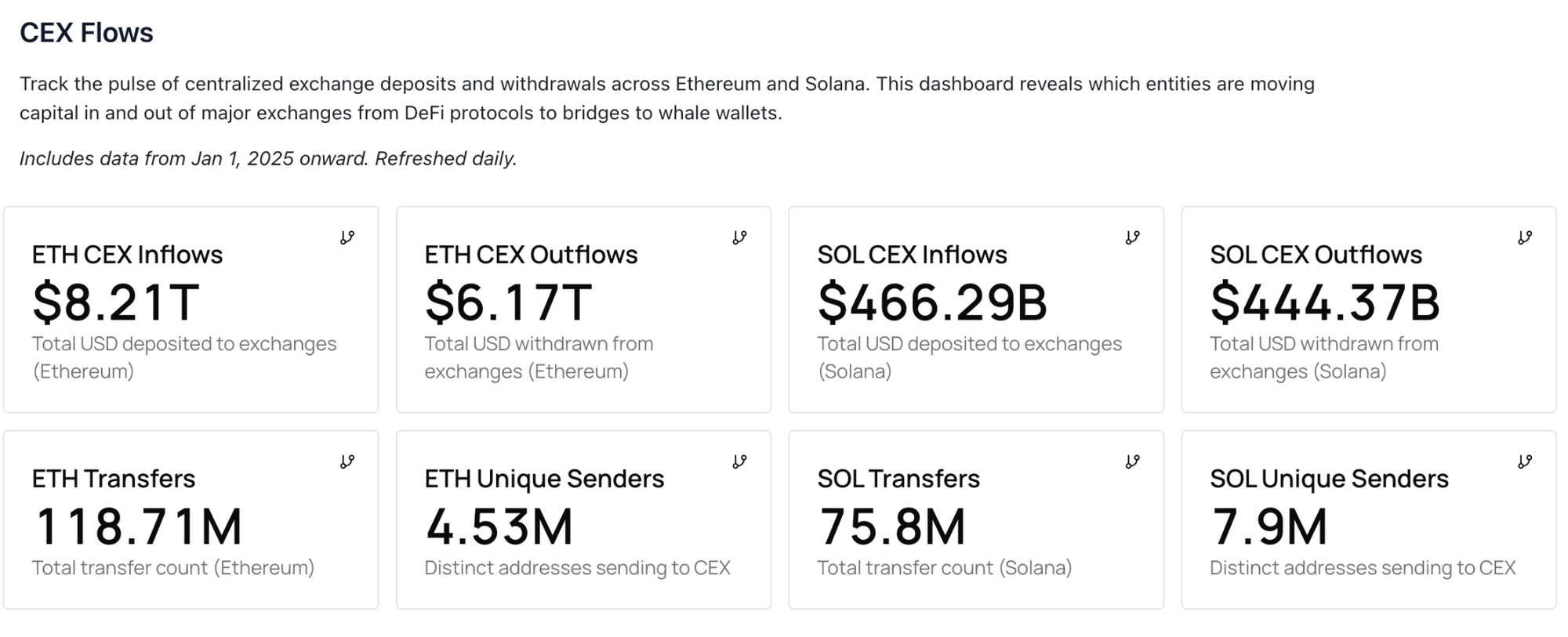
None of these CEX numbers are readable from raw transfer data alone — they only become meaningful once individual addresses are attributed to the exchanges receiving and sending the funds.
Business vs. Consumer Wallet Classification
Entity attribution also feeds into how Allium classifies wallets by type.
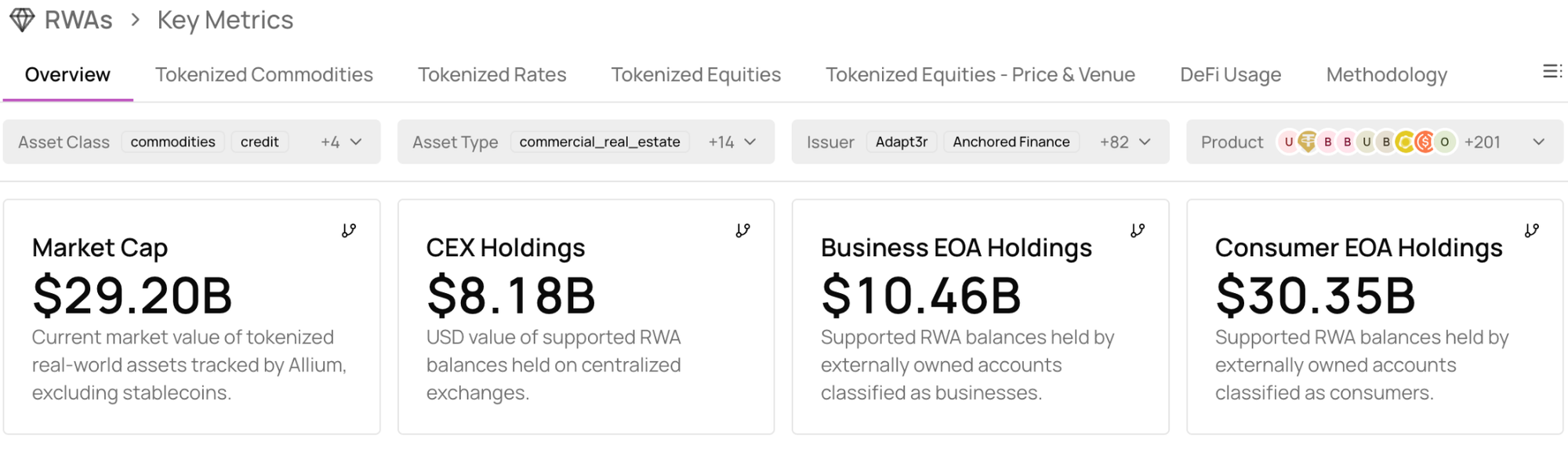
On the RWA Key Metrics dashboard, externally owned accounts holding tokenized real-world assets are split into Business EOA Holdings ($10.46B) and Consumer EOA Holdings ($30.3BB). That split comes from wallet-level behavioral classification, not a self-reported field, so it holds up even when the wallet owner never identifies themselves.
Payment Behavior Classification
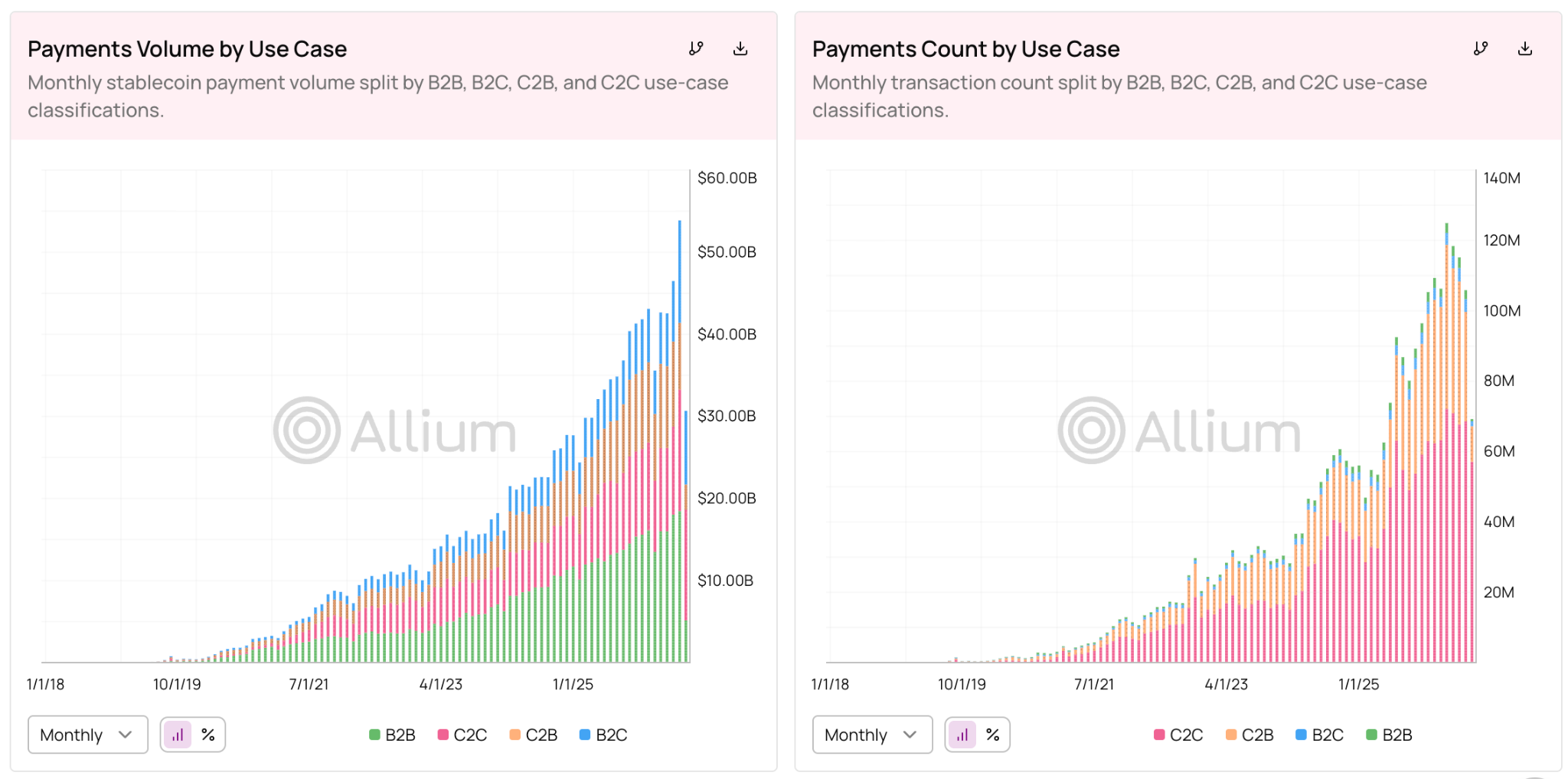
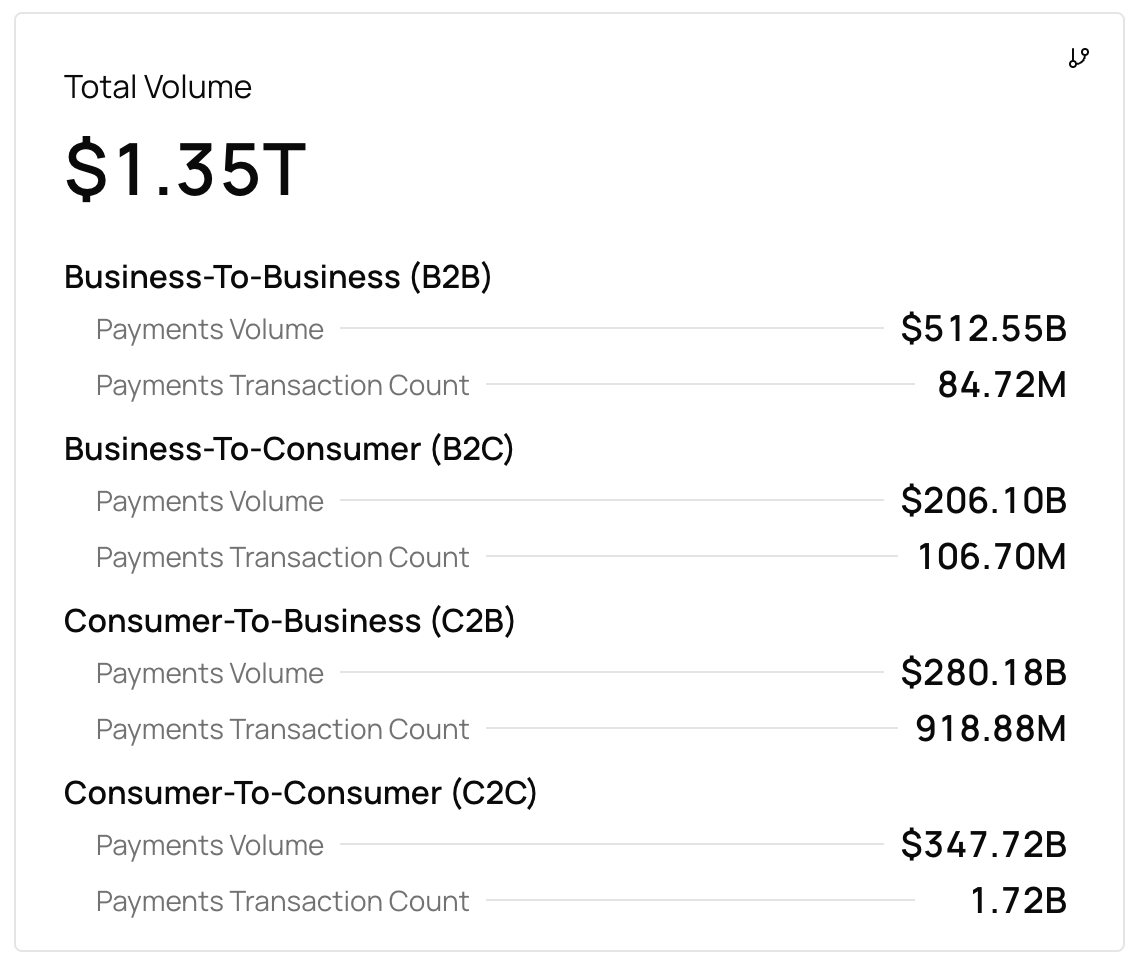
The Payment Use Cases dashboard goes a step further, sorting payment activity into categories like business-to-business, business-to-consumer, and consumer-to-consumer flows. This classification combines entity labels with transaction-pattern analysis to infer the nature of a payment relationship, something that would otherwise require manually reviewing individual transactions one at a time.
What Should You Keep in Mind About Entity Labels?
Entity labels are a strong signal, but they shouldn’t be considered a guarantee.
A cluster represents Allium's best current read on which addresses belong together, built from real transaction and behavioral evidence, and it can be refined as new data comes in. Where multiple possible attributions exist for an address, that's worth treating as a reason to dig a little further rather than as a reason to distrust the label entirely.
Wallet clustering turns anonymous addresses into something closer to real economic behavior: who's holding what, who's moving capital where, and how. Compliance teams looking for blockchain intelligence platforms should consider how granular the entity-level visibility is. A platform like Allium Terminal gives teams that kind of visibility without the need to know SQL or write queries.
FAQs About Wallet Clustering on Allium Terminal
How is wallet clustering different from a single address label?
A single address label identifies one address. Clustering goes further by connecting that address to every other address controlled by the same entity, giving a fuller picture of an entity's total onchain footprint.
Do I need to write SQL to see entity labels in Allium Terminal?
No, you don’t need to write SQL to see entity labels on Allium TErminal. Entity attribution is built into dashboards like Labeled CEX Flows, RWA Key Metrics, and Payment Use Cases, so labels and classifications are visible without writing a query.
How does Allium know two addresses belong to the same entity?
Allium starts from known seed addresses for a given entity, traces fund-flow patterns to and from those addresses, and confirms matches using behavioral signals like transaction timing and counterparty overlap.
How confident is an entity label?
Entity labels are deterministic and every attribution includes its source, so you know how it was derived. Labels backed by public disclosures or manual verification carry the highest confidence, while heuristic-based labels are transparently identified and continuously validated as new onchain activity emerges.
Where in Allium Terminal can I see entity attribution in action?
Entity attribution shows up across multiple dashboards, including exchange deposit and withdrawal tracking, business versus consumer wallet classification, and payment behavior categorization.