Can You Price an IPO Before the IPO?
Companies stay private longer, so investors and reporters increasingly try to read a company's value before its IPO. Here is how pre-IPO pricing actually works, what signals it, and where the gaps are.

Yes, you can put a price on a company before its initial public offering, but here is the more useful answer: there is no single pre-IPO price anymore. Instead, there is an emerging set of observable market signals that each price the same company differently. A private funding round, a secondary sale of employee shares, a tokenized claim on private stock traded on a blockchain, a prediction market on when the company will list, and a perpetual futures contract can all point at one company and produce different numbers. None of them is the IPO price itself, which is fixed only when underwriters and the company set it on the eve of the public listing.
The interesting part is not whether a number exists. It is that several venues now publish their own numbers, in the open, and reading them means understanding what each one actually prices and where each one misleads.
Key takeaways
- There is no single pre-IPO price. Private rounds, secondary trades, tokenized pre-IPO stock, prediction markets, and perpetual futures each produce a different figure for the same company.
- These signals exist because companies now stay private far longer. Value that once formed in public markets now forms before the IPO.
- Some of this exposure now trades in observable venues. Tokenized pre-IPO stock and prediction markets on IPO timing and valuation make the question answerable in a way private paper trades never did.
- Every signal misleads in its own way. Thin trading, restricted access, and limited disclosure mean a single trade can move an implied valuation sharply.
- Reading these markets requires clean transaction data. Onchain records make tokenized pre-IPO activity observable in ways private paper trades are not.
Why this exists, and what people did before
An initial public offering, or IPO, is the moment a private company first sells shares to the general public on a stock exchange. For most of the twentieth century, companies went public relatively early in their lives, so the public market did the work of pricing them. If you wanted to own a piece of a fast-growing firm, you waited for the IPO and bought at the opening bell.
That changed. Large pools of private capital, from venture funds to sovereign wealth funds, now let companies raise billions while staying private. Firms like SpaceX and Stripe have operated for well over a decade without a public listing. The result is that enormous value forms before any IPO happens, and it forms in private, where prices are set in negotiated rounds rather than open trading.
That created demand for a way to price these companies early. Employees holding stock options wanted to sell. Early investors wanted liquidity. New buyers wanted in before the public did. In response, a scattered set of venues grew up around private companies, and increasingly some of that pre-IPO exposure trades in the open. Tokenized pre-IPO stock (a blockchain-based claim that tracks a private company's shares), prediction markets that let people bet on when a company will list and at what valuation, and perpetual futures contracts now put prices on private companies that anyone can watch. That is what makes the question answerable at all.
Why you should care, even if you never trade
Pre-IPO pricing matters well beyond the people buying and selling. For a journalist, a jump in a private company's implied valuation is a story about market sentiment before any official filing exists. For a regulator, active trading in private-company claims raises questions about disclosure and investor protection in a market with far less oversight than public exchanges. For a TradFi analyst, pre-IPO prices are an early read on how a future listing might be received.
For an ordinary investor, the significance is subtler. Much of a company's growth now happens before it reaches the public. By the time a firm rings the opening bell, a large share of its appreciation may already be captured by private holders. Understanding pre-IPO pricing is part of understanding why public IPOs sometimes look richly valued from day one.
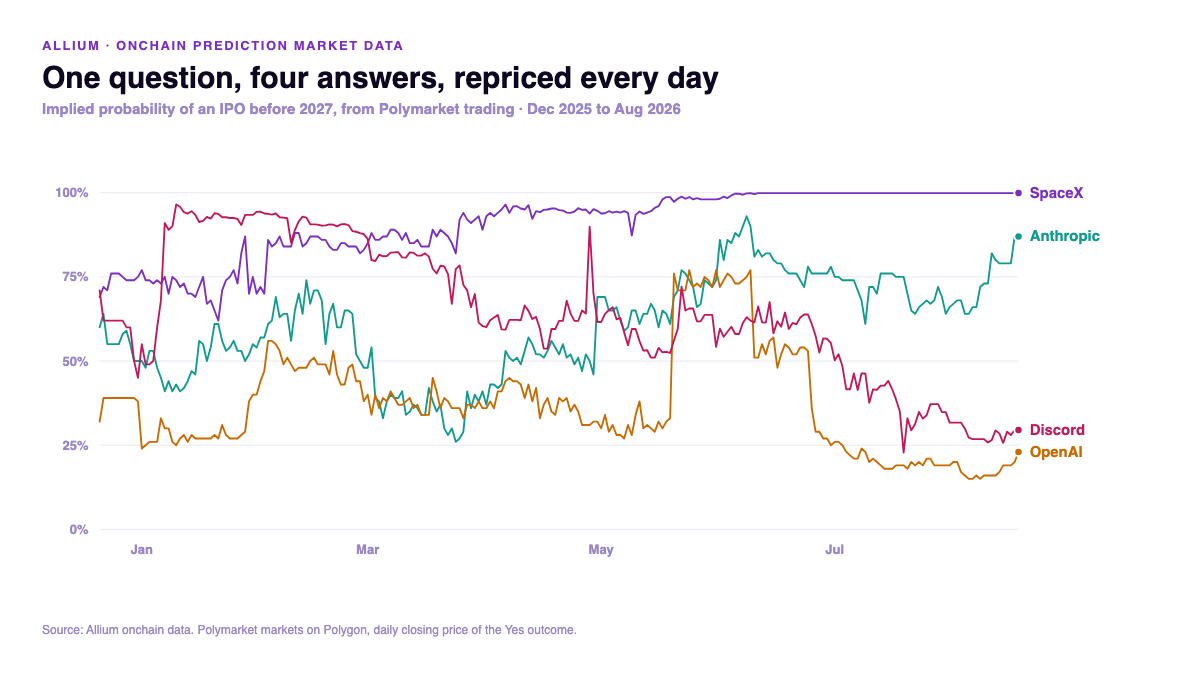
The chart above is one way to see the point. It reads four Polymarket markets that all ask the same question, whether a company will go public before 2027, and tracks what traders paid for the Yes side each day between December 2025 and August 2026. The four answers went in four directions. SpaceX started around 69 cents and walked up to near certainty. Anthropic climbed from about 60 cents to the high 80s, touching 93 along the way. Discord ran to 96 cents early in the year and then gave almost all of it back, ending near 30. OpenAI never got above the high 70s and drifted down to the low 20s. None of these is the company's valuation. Each is a price on a specific event, set by people with money at stake, updated daily and visible to anyone. That is what an observable signal looks like, and it is why the honest answer to the headline question is that you can read several prices rather than look up one.
The signals, and what each one tells you
Because there is no single price, it helps to treat each venue as a separate signal. Each one prices something slightly different, is visible to a different audience, and misleads in its own way.
Funding rounds
When a company raises money, it sells new shares to investors at a negotiated price. That price times the total share count gives a headline valuation. This is the most cited pre-IPO number, but it is a point-in-time negotiation between a small set of parties, not a continuous market price. A round priced months ago may not reflect current sentiment. Where it misleads: it can go stale fast, and headline valuations often ignore the special terms attached to a round.
Secondary sales
Employees and early investors sometimes sell existing shares to new buyers, often through specialized brokers or platforms. These secondary trades give a fresher signal than a stale funding round, because they happen between a willing buyer and seller today. They are usually private, restricted to accredited investors, and reported with a lag if at all. Where it misleads: you rarely see the whole picture, and a single motivated seller can set a price that looks more meaningful than it is.
Tokenized pre-IPO stock
A newer approach issues a token, a blockchain-based digital claim, designed to track the value of a private company's stock. Because these tokens trade on public blockchains, their transactions are visible in a way private paper deals are not. Bloomberg has cited Allium data on pre-IPO tokenized stock volume for SpaceX, an example of how this activity can be measured directly from onchain records. Where it misleads: the token is a claim, not always direct ownership, and its legal status varies by product and jurisdiction. For how these instruments are structured, see how onchain stocks work.
Prediction markets
Some venues let people bet directly on IPO questions: will this company list this year, and at what valuation. The odds these markets settle on are a live read on collective expectations, expressed as a probability rather than a share price. Where it misleads: they price events, not equity, so a high probability of an IPO tells you little about the price per share, and thin markets swing on small bets.
Perpetual futures
A perpetual future is a contract whose value tracks an asset without an expiry date. Some venues offer perpetuals referencing private companies, giving continuous, tradable exposure to a price without any claim on the underlying shares. Where it misleads: the price reflects trading demand and funding costs on the venue, which can drift away from any fundamental valuation, especially when liquidity is thin.
Analogy: an election bet before the votes are counted
Think of an IPO as an election result announced on a set day. A pre-IPO price is like the odds two friends agree on beforehand when betting on the outcome. Those odds are a real signal about what informed people expect, but they are not the result. They can be wrong, they can swing on thin information, and the people setting them may know things you do not. When many people bet, the odds get sharper. When only a few do, one large wager distorts everything. Pre-IPO markets behave the same way, and the parallel to prediction markets is literal, not just figurative, because some of these signals are prediction markets.
Comparing the ways a company gets priced
| Signal | What it prices | Who can see it | How reliable it is |
|---|---|---|---|
| Funding round | Equity, at a negotiated point in time | Round participants, headline announced publicly | Authoritative but can go stale quickly |
| Secondary sale | Existing shares between insiders and buyers | Mostly accredited investors, reported with a lag | Fresher than a round, but sporadic and partial |
| Tokenized pre-IPO stock | A tracking claim on private shares | Anyone, recorded on public blockchains | Continuous and observable, but legal status varies |
| Prediction market | The odds of an IPO event, not the share price | Anyone on the venue | Good read on expectations, weak read on price per share |
| Perpetual future | Continuous exposure to a price, no share claim | Anyone on the venue | Can drift from fundamentals, especially when thin |
| The IPO itself | The official offering price | Fully public and regulated | The settled price, set by underwriters and the company |
What tokenization changes, concretely
Tokenized pre-IPO shares do not change what a company is worth. They change how the trading around it can be seen and settled. The concrete differences matter.
- Visible pricing before an IPO: instead of relying on leaked round figures or occasional broker chatter, an analyst can observe actual trade prices recorded on a blockchain. That turns a rumor into a data point.
- Faster settlement: traditional private secondary sales can take weeks to close, with capital locked up while paperwork clears. Tokenized transfers can settle in minutes, so funds are not tied up waiting.
- Continuous availability: a token can trade outside the negotiated windows of a formal secondary process, so a fresh price can exist on a Sunday, not only when a broker arranges a block.
Making sense of many tokenized venues at once raises a further problem: piecing scattered trades into one comparable price. That challenge is the subject of a consolidated tape for tokenized equities.
Where the data comes from
Reading any of these signals depends on clean, comparable records. Private funding rounds and secondary sales live in filings and broker disclosures that are slow and incomplete. Tokenized activity, by contrast, is recorded on public blockchains, but raw blockchain data is messy and hard to interpret without standardization. Allium is a data foundation for onchain finance that ingests raw data from many blockchains and normalizes it into labeled, verifiable datasets. It is a read layer, not a venue, exchange, broker, or custodian, and it does not offer investment advice. That is why Bloomberg has cited Allium data on pre-IPO tokenized stock volume for SpaceX: the underlying trades are observable, once the raw records are cleaned and standardized.
Risks and open questions
Pre-IPO pricing is genuinely useful and genuinely unsettled. The honest picture includes several open issues.
- Thin markets distort prices. With few trades, a single motivated buyer or seller can swing an implied valuation. A pre-IPO price should be read as a signal with wide error bars, not a firm quote.
- Access is uneven. Many pre-IPO instruments are restricted to accredited or institutional investors, and the price you see may not be one you can actually transact at.
- Legal status varies. Whether a tokenized pre-IPO instrument is a security, how it maps to the underlying shares, and what rights the holder actually has are questions that differ by jurisdiction and product. Some structures give exposure to price without direct ownership. Custody and settlement rules such as SEC Rule 15c3-3 for tokenized securities are still being worked through. This is a description of the state of play, not legal advice.
- Disclosure is limited. Private companies are not required to publish the financials that public issuers must. A pre-IPO price reflects less verified information than a public share price.
- The IPO can reprice everything. A private valuation and an eventual IPO price can diverge sharply, and companies have listed both above and below their last private marks.
The direction of travel is clear enough. Companies stay private longer, more value forms before the public ever gets access, and the tools for pricing that private value are getting more visible. So the answer to the question is really this: you cannot pull one pre-IPO price, because there is no single number to pull. What you can do is read a spread of signals, private rounds, secondary sales, tokenized stock, prediction markets, and perpetuals, each pricing the same company from a different angle. Whether those signals converge into something as trusted as a public quote will depend on liquidity, disclosure, and how regulators treat the newer instruments. For now, treat each number as an informed estimate, and treat the gap between them as information in its own right.
Frequently asked questions
Can you actually price an IPO before the IPO happens?
You can produce estimates of a company's value before its IPO, but not a single price. Funding rounds, secondary sales of insider shares, tokenized pre-IPO stock, prediction markets, and perpetual futures each price the same company differently. None of these is the official IPO price, which underwriters and the company set only just before the public listing. Treat each as an informed signal with wide margins of error.
Why is there no single pre-IPO price?
Different venues price different things. A funding round prices equity at a negotiated moment, a secondary sale prices existing shares between a buyer and seller, a tokenized token prices a claim tracking the shares, a prediction market prices the odds of an IPO event, and a perpetual future prices continuous exposure without any share claim. They point at one company and produce different numbers.
What are tokenized pre-IPO shares?
They are blockchain-based digital claims designed to track the value of a private company's stock. Because they trade on public blockchains, their transactions are visible and can settle quickly. Their legal status, and exactly what rights the holder has to the underlying shares, varies by product and jurisdiction.
Why are pre-IPO prices considered less reliable than public prices?
Private markets trade thinly, so a single large trade can move an implied valuation sharply. Access is often restricted to accredited or institutional investors, and private companies disclose far less financial information than public issuers, so the price reflects less verified data.
How can you observe pre-IPO trading activity?
Private paper trades are slow and often unreported, but tokenized pre-IPO activity is recorded on public blockchains and can be measured directly. Standardizing that raw data is how firms like Allium make onchain pre-IPO volume observable; Bloomberg has cited Allium data on pre-IPO tokenized stock volume for SpaceX.
Does a pre-IPO valuation predict the IPO price?
Not reliably. A private valuation and the eventual IPO price can diverge significantly, and companies have gone public both above and below their last private marks. A pre-IPO price is a signal about expectations, not a forecast of the official listing price.
Interested in learning more about Allium’s pre-IPO and private market data? Speak to someone on the team.