5 Workflows You Can Build With Allium MCP Today

Allium MCP is a standardized interface that allows AI agents to interact with blockchain data. In practice, this means that builders can create applications that analyze wallets, monitor DeFi positions, track stablecoin flows, and anything else they require with blockchain data.
Most teams don't struggle to build AI agents. They struggle to give those agents access to reliable blockchain data.
Allium MCP solves that problem. Instead of spending weeks building custom indexers, protocol integrations, and data pipelines, teams can give AI agents access to normalized blockchain data across 150+ chains through natural language.
Below are five workflows teams are already building today with Allium MCP.
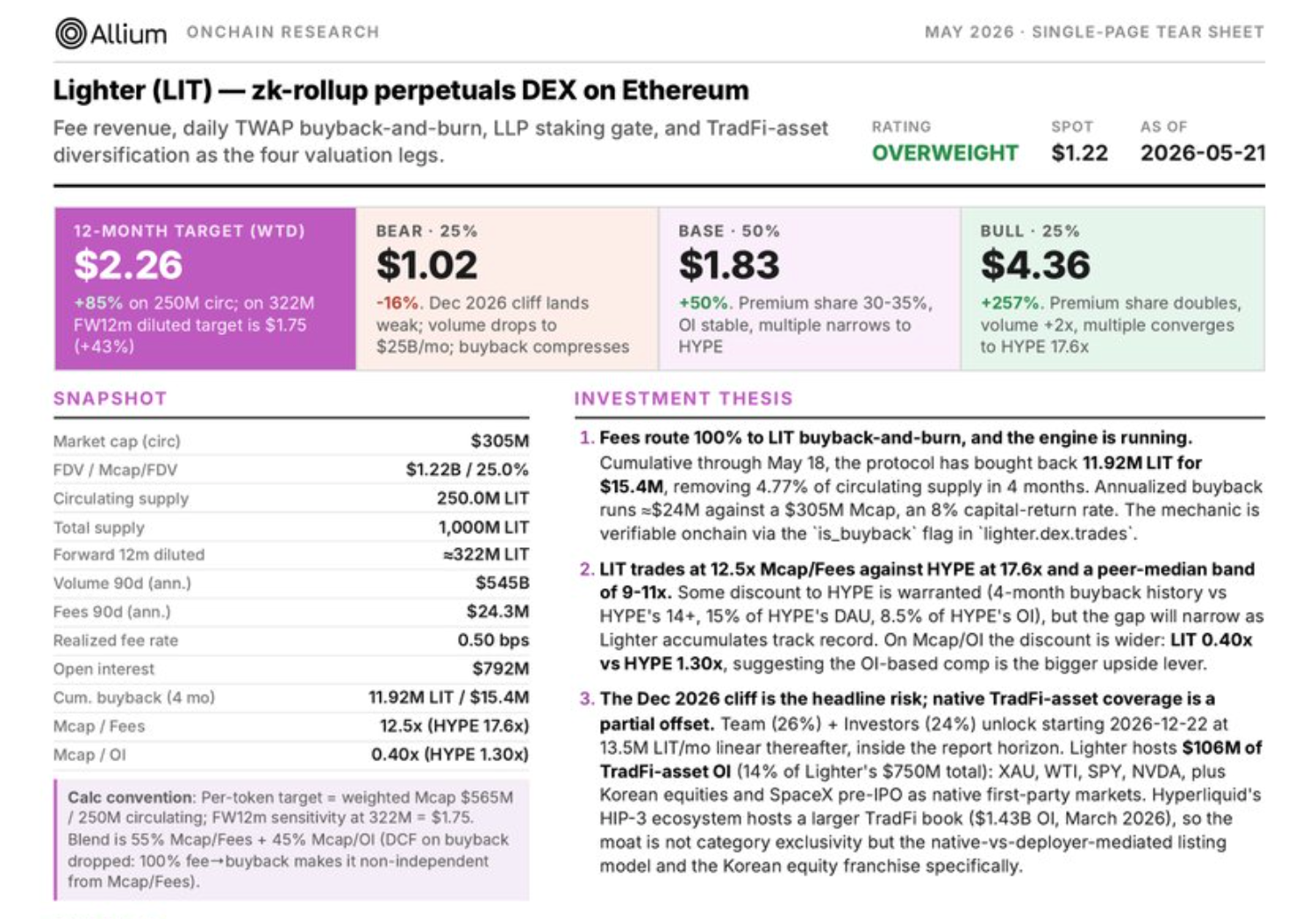
Our first example — if you give Allium MCP a contract address and ask it to value a token, it can return a full report in 15 minutes.
Connecting Your Agents to Allium MCP
Before building any of the workflows below, you’ll need to connect your agent to the Allium MCP server.
Install the Allium MCP server
Run the installer using the below:
npx @allium-labs/mcp install
You’ll then need to generate an API key, restart your client, and you’re ready to query.
For a more in-depth walkthrough, check out this MCP overview page from Allium’s documentation.
Workflow #1: Build a Portfolio Analyst in Minutes
Allium MCP allows users to use natural language to ask questions about wallet performance, rather than manually calculating gains, losses, and holdings across multiple tokens and protocols.
Who builds this?
- Individual crypto traders
- Wallet app builders
- Trading firms
- Tax and accounting platforms
- Research teams
- Social trading products
The Workflow
Step 1: Provider a wallet address (or addresses)
0x123…
Step 2: Ask a question
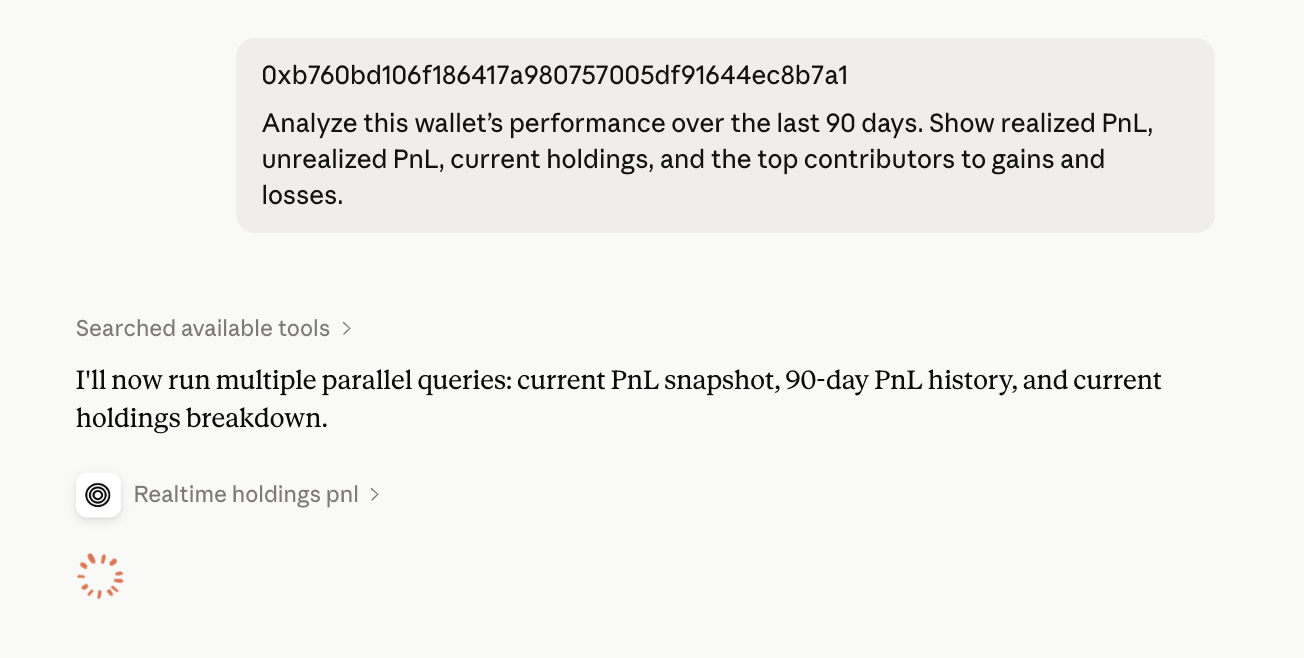
Analyze this wallet’s performance over the last 90 days. Show realized PnL, unrealized PnL, current holdings, and the top contributors to gains and losses.
Step 3: MCP retrieves data from Allium
The agent can access:
/wallet/pnl
/wallet/holdings
/wallet/prices
Example output
To the above query, the agent would return the following:
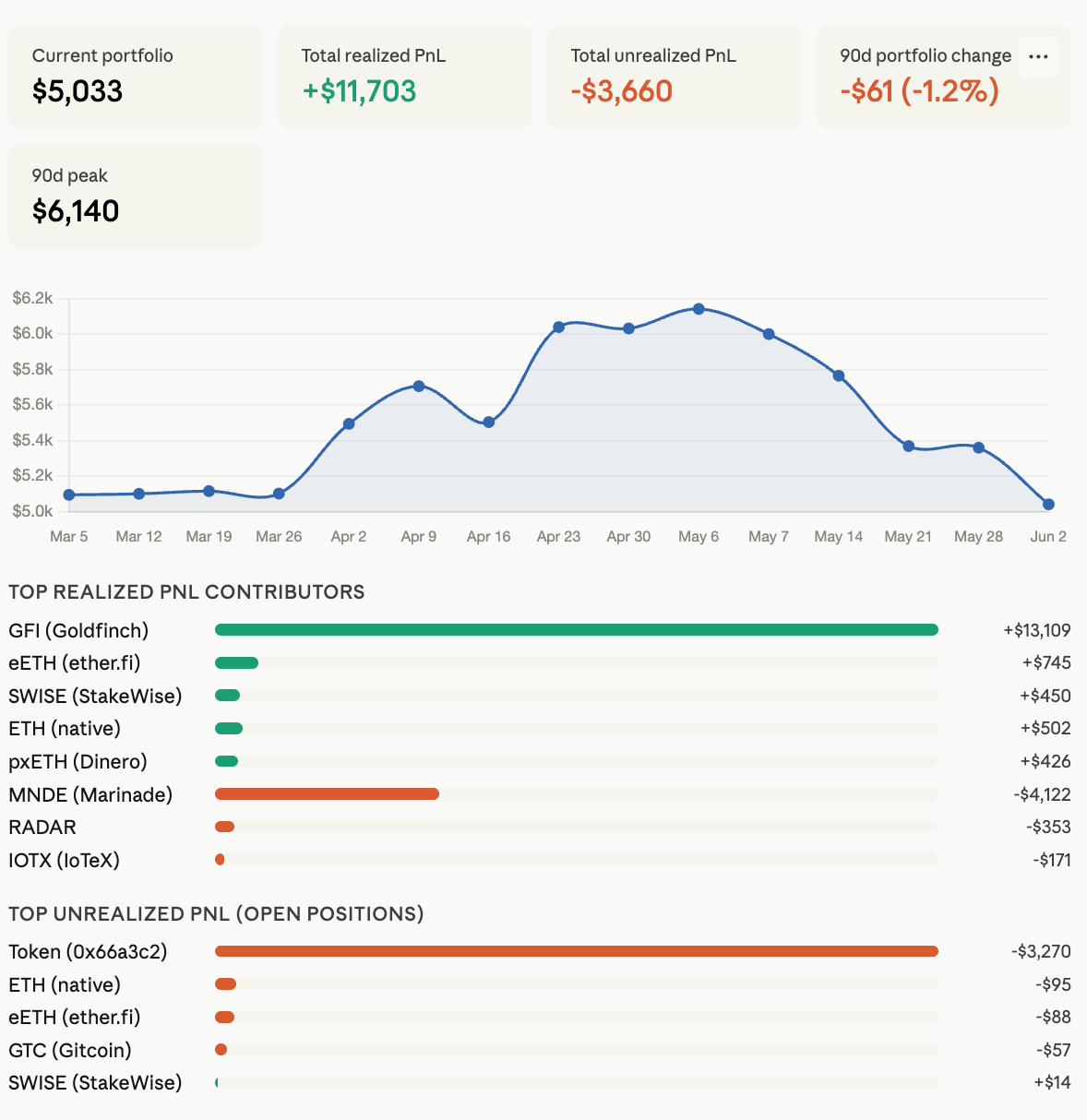
Teams building wallets can change this query to create portfolios for each of their users.
Workflow #2: Build an Onchain Due Diligence Agent
Creating an onchain due diligence agent can help investors evaluate growth and protocol activity directly from underlying blockchain within one interfact.
Who builds this?
- Venture capital firms
- Hedge funds
- Research platforms
- Business development teams
- Ecosystems funds
- Institutional investors looking into onchain opportunities
The Workflow
Step 1: Provide the entity to analyze
Evaluate Protocol A before allocating capital.
Step 2: Ask a due diligence question
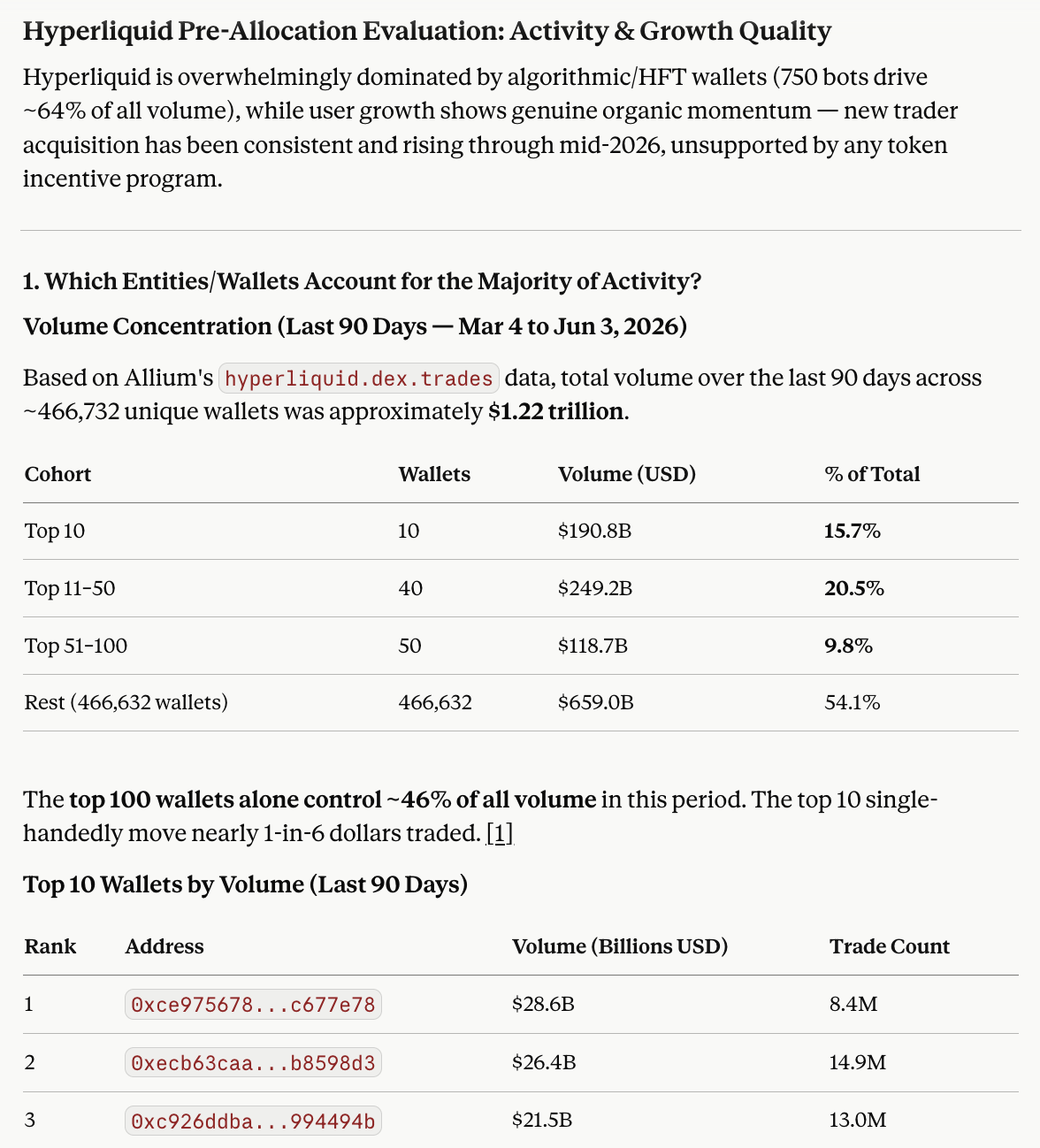
Rather than stitching together dashboards, token terminal metrics, governance posts, and raw blockchain data, the agent can generate a unified investment memo directly from onchain activity:
How has Protocol A grown over the last six months?
Where is liquidity coming from?
Are users retaining capital after incentives end?
Which entities or wallets account for the majority of activity?
Is recent growth organic or incentive-driven?
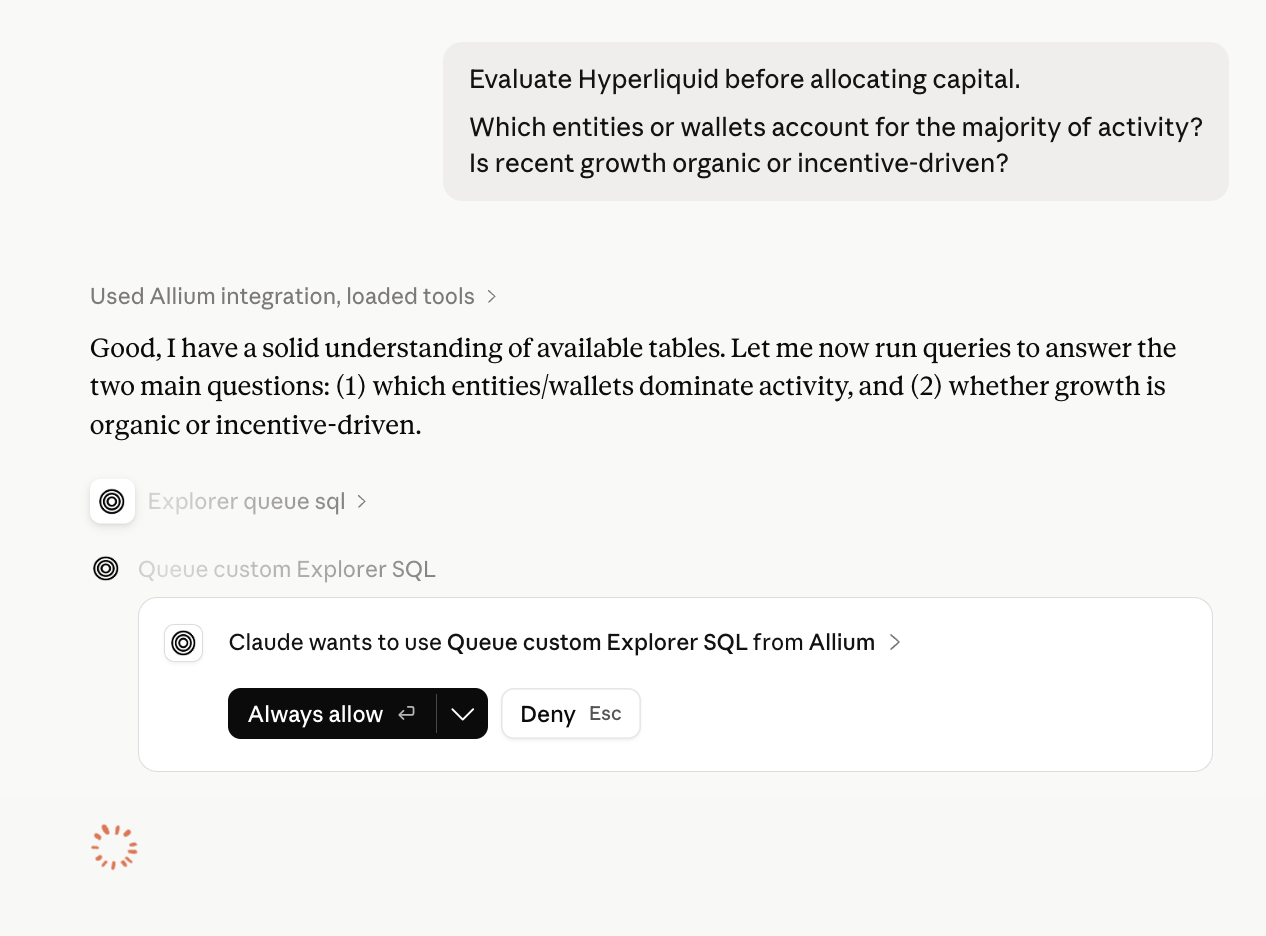
Step 3: MCP retrieves and analyzes onchain activity
Just like an employee, Allium MCP will pull together the relevant data and generate a research summary.
Example output
Workflow #3: Build a Protocol Growth Analyst
Who builds this?
- Protocol teams
- Investor relations teams
- Growth and ecosystem teams
- Research platforms
- Venture capital firms
- Hedge funds
The Workflow
Step 1: Provide the protocol to analyse
Monitor weekly growth metrics for Protocol A.
Step 2: Ask a growth question
What is driving growth for this protocol?
Which chains are contributing the most new users?
Are users returning after their first interaction?
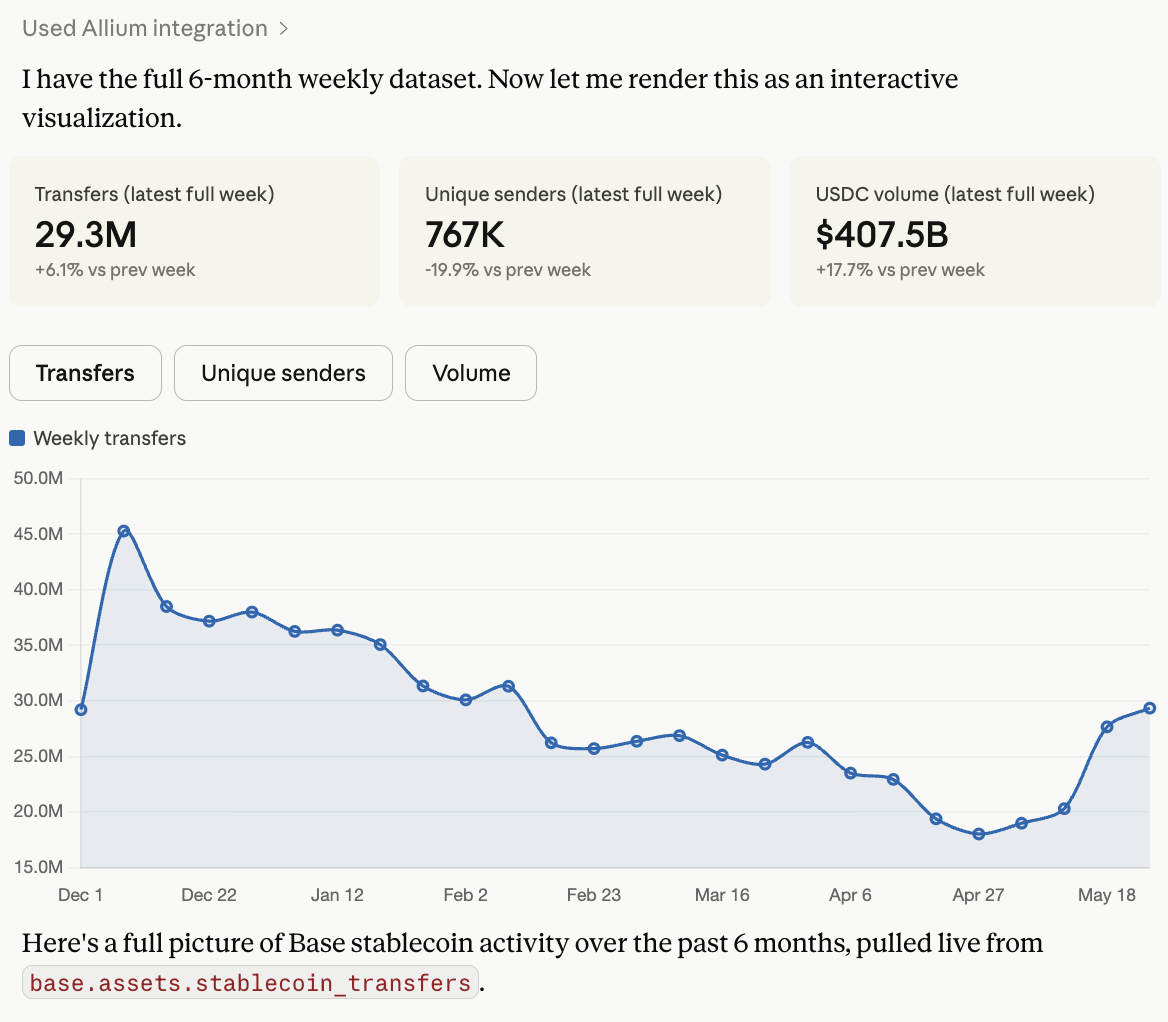
How has stablecoin activity changed over time?
Is growth accelerating or slowing?
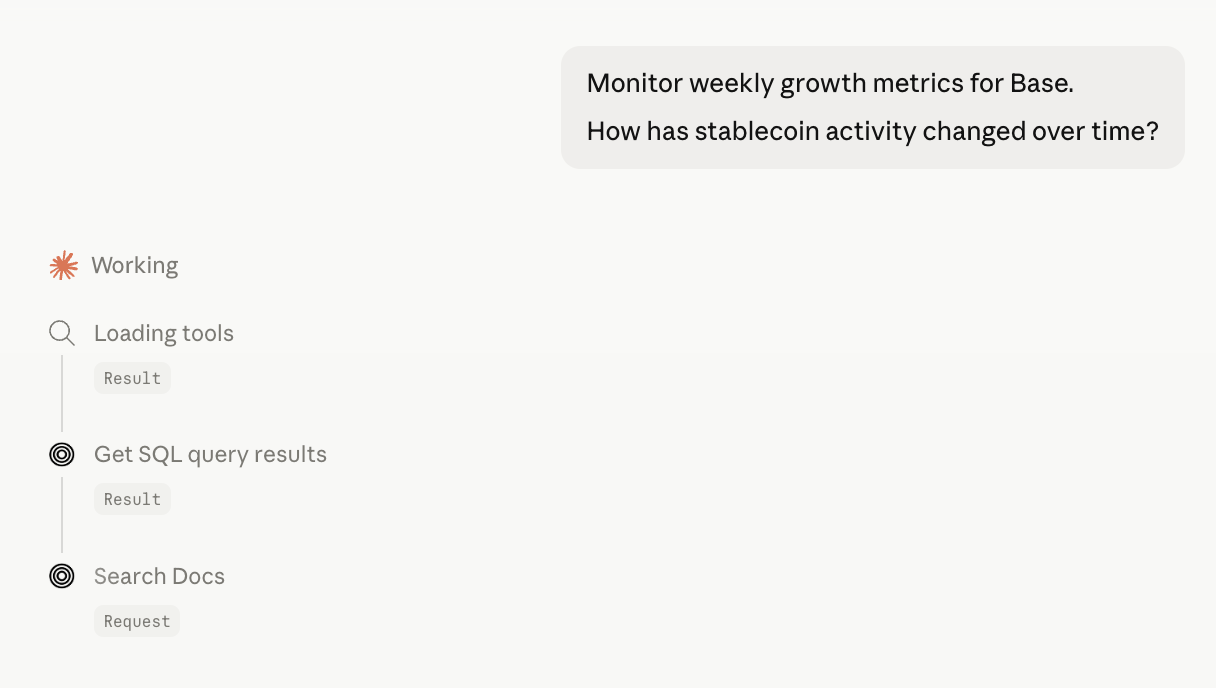
Step 3: MCP retrieves and analyzes growth metrics
The agent then analyzes protocol activity and identifies the key growth drivers.
Example output
Workflow #4: Build a DeFi Risk Analyst
A DeFi monitoring tool will help users better understand their exposure across all protocols, lending pools, and staking systems through a single interface.
Builders traditionally solve for this understanding with protocol-specific integrations and custom logic: Allium MCP streamlines that multi-pronged approach.
Who builds this?
- Wallet applications
- Portfolio trackers
- Trading firms
- Treasury teams
- Wealth management platforms
The Workflow
Step 1: Provide wallet context
Your application already knows which wallets belong to which users. When looking to monitor DeFi positions across the board, pass the relevant wallet address to the agent as context.
For example: Analyze all wallets associated with Fund A and summarize current DeFi exposure.
Step 2: Ask a portfolio question
Depending on your team’s needs, questions like the below can continue the building process:
Which protocols represent our largest concentration risk?
Where is most of our capital currently deployed?
Which positions are generating the most yield?
Show all active lending, staking, and LP positions across the portfolio.
Step 3: MCP retrieves and analyzes position data
Instead of returning raw blockchain data, the agent generates a portfolio-level view.
Example output
Workflow #5: Build a Stablecoin Treasury Monitor
Any company working with stablecoins — crypto-native firms, institutional financial providers — need to have a deep understanding of their own (or their users’) stablecoin activity.
With new US regulation on the horizon with the upcoming passage of the CLARITY Act, Allium MCP lets teams build stablecoin treasury monitoring using natural language alone.
Who builds this?
- Stablecoin issuers
- Fintech platforms
- Payment companies
- Crypto exchanges
- Protocol treasury teams
- Asset managers operating onchain
The Workflow
Step 1: Provide treasury context
The agent needs access to any wallets, entities, or treasury addresses that should be continuously monitored.
For example: Track all stablecoin activity across our operating, settlement, and reserve wallets.
Step 2: Ask an operational question
Operational questions can range from specifics on treasury activity to capital movement and risk.
Some examples:
Summarize all stablecoin movement over the last 24 hours.
Identify all transfers over $1 million.
Show all stablecoin flows between treasury wallets and external entities.
Step 3: MCP retrieves and analyzes treasury activity
Through MCP, the agent will analyze all stablecoin activity: large transfers, counterparty activity, incoming and outgoing flows, cross-chain treasury movements, etc.
Example output
FAQs About Allium MCP
What can Allium MCP do?
Allium MCP allows AI agents to discover schemas, execute SQL, run Explorer queries, and access blockchain data through structured tool calls.
Do I need to build my own agent?
No, you don’t need to build your own agent. Allium MCP works with MCP-compatible tools such as Claude, Cursor, VS Code, Windsurf, and others.
Can Allium MCP query blockchain data directly?
Yes, Allium MCP can query blockchain directly. Agents can access blockchain datasets through Allium's MCP server without requiring custom API integrations.
Is MCP only useful for developers?
No, MCP is useful for roles outside of engineering: analysts, researchers, compliance teams, and operations teams can use natural-language workflows on top of blockchain data.
What types of workflows work best with MCP?
Research, monitoring, portfolio analysis, due diligence, compliance investigations, and data exploration work very well with MCP because they involve repeated interaction with structured data.
How is MCP different from a chatbot?
A chatbot generates responses. MCP allows AI systems to interact with external tools and data sources while producing those responses.
MCP Makes Data Infrastructure Accessible
Looking across all five workflows, a common pattern emerges.
The value is not that AI suddenly knows how to analyze wallets, monitor treasury activity, investigate protocols, or evaluate portfolio risk. Those workflows have existed for years. What MCP changes is the interface.
AI agents are becoming a new interface for financial software.
The challenge is not reasoning. The challenge is data.
Allium MCP gives agents access to institutional-grade blockchain data across wallets, protocols, stablecoins, DeFi, and market activity through a single interface.
Builders can spend less time integrating data sources and more time building products.
The result is a new class of applications: portfolio analysts, treasury monitors, risk systems, research assistants, and intelligence platforms powered directly by onchain data.